Trump recently promised he wouldn’t get the U.S. into a war. It’s the kind of line every politician delivers, and most people nod along without thinking about it too hard. But this one stuck with me, not because of what he said, but because of what it exposed.
Republicans and Democrats don’t just disagree about war policy. They disagree about what the word “war” means.
Look at the pattern. Republican military engagements have historically come with specific goals, timelines, and exit strategies. H.W. Bush’s Gulf War had a clear objective, liberate Kuwait, a broad coalition and a withdrawal. Reagan’s Grenada was in and out. Democratic military engagements, by contrast, have a habit of becoming open-ended nation-building projects: LBJ’s Vietnam, Obama’s Libya.
Clean story. Except it falls apart the moment you say the name George W. Bush.
A Republican president launched the two longest, most expensive military engagements in modern American history. Afghanistan and Iraq both became exactly the kind of open-ended nation-building the pattern was supposed to attribute to Democrats. The neoconservative movement that drove those wars had more in common with liberal interventionists than with traditional Republican restraint. Two completely opposite foreign policy approaches were wearing the same party label, and most people never noticed, because they were holding the Handle instead of the Principle.
If you read yesterday’s article on Handles vs. Principles, you know what that means. The standard political labels don’t predict behavior because they describe brands, not mechanisms. Republican vs. Democrat tells you which jersey someone wears. It doesn’t tell you what game they’re actually playing.
To see the real pattern, you need a different map.
Here’s what that map looks like.
What’s Wrong with the Standard Spectrum
The political spectrum you learned in school is a single horizontal line. Communism on the far left, Fascism and Nazism on the far right, with reasonable moderates in between.
It’s elegant, simple, and wrong in ways that aren’t accidental.
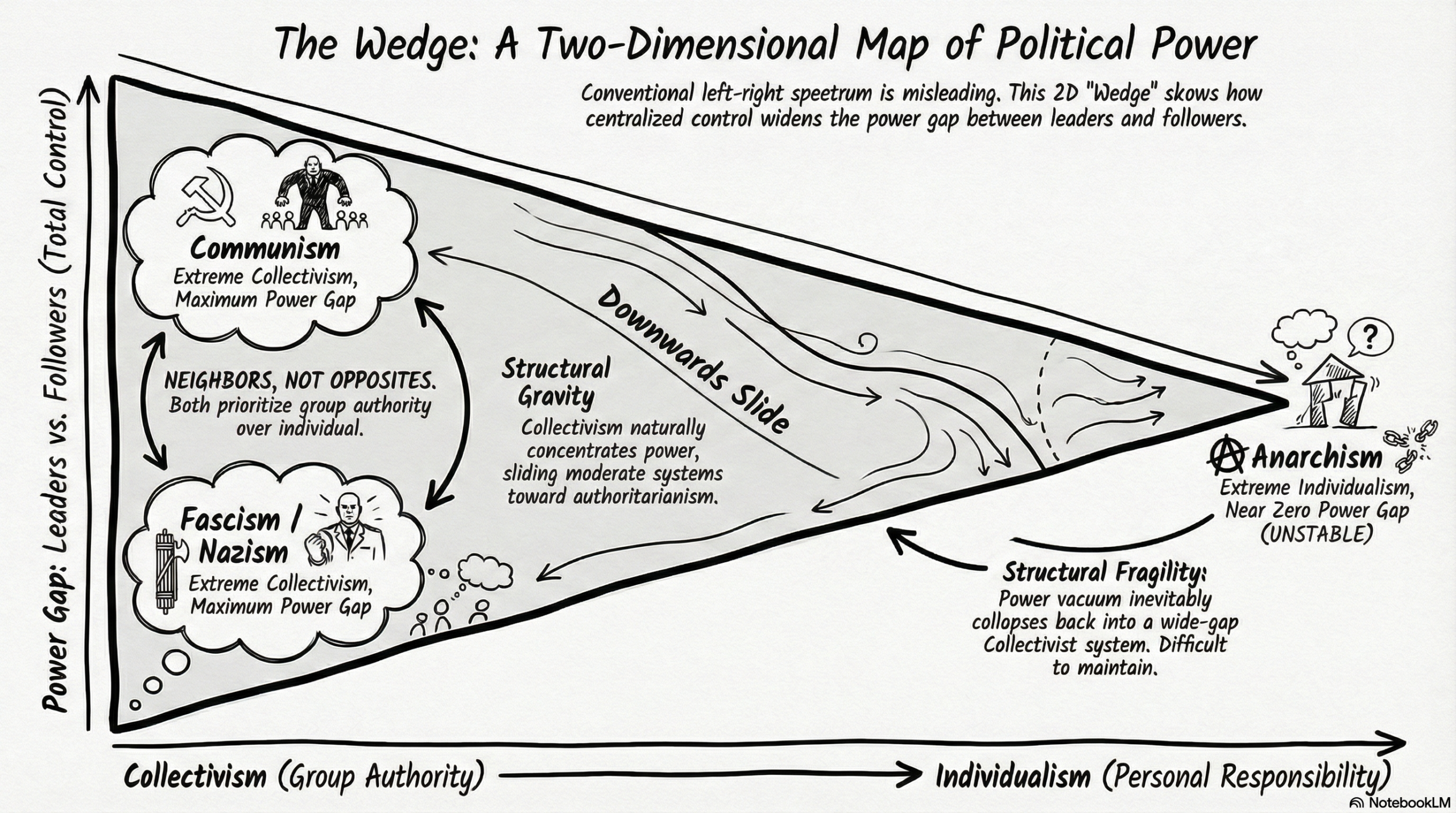
The first problem is that both extremes are Collectivism. Both Communism and Nazism subordinate the individual to the group. Both produce authoritarian hierarchies, state control of industry, suppression of dissent, and personality cults. They differ in their organizing principle, class versus ethnicity, but not in structure. If both ends of your spectrum are the same thing, your spectrum is a line folded back on itself. The “extremes” aren’t far apart. They’re neighbors.
The second problem is that Individualism has no home on this spectrum. Where does the belief that the individual is sovereign and government should be minimal, actually sit? There’s no place for it. The spectrum was built without a seat for it. That’s not an oversight. That’s architecture.
The third problem is that the “center” looks inherently reasonable by default. If both extremes are evil, then the middle must be good. But the middle of a spectrum between two forms of Collectivism is just moderate Collectivism. Every “reasonable” position on this map is some flavor of collective control. You literally cannot move toward Individualism because there’s nowhere to go.
The standard political spectrum is itself a Handle. It looks like it explains something while actually preventing you from seeing the real divide.
The Two Axes
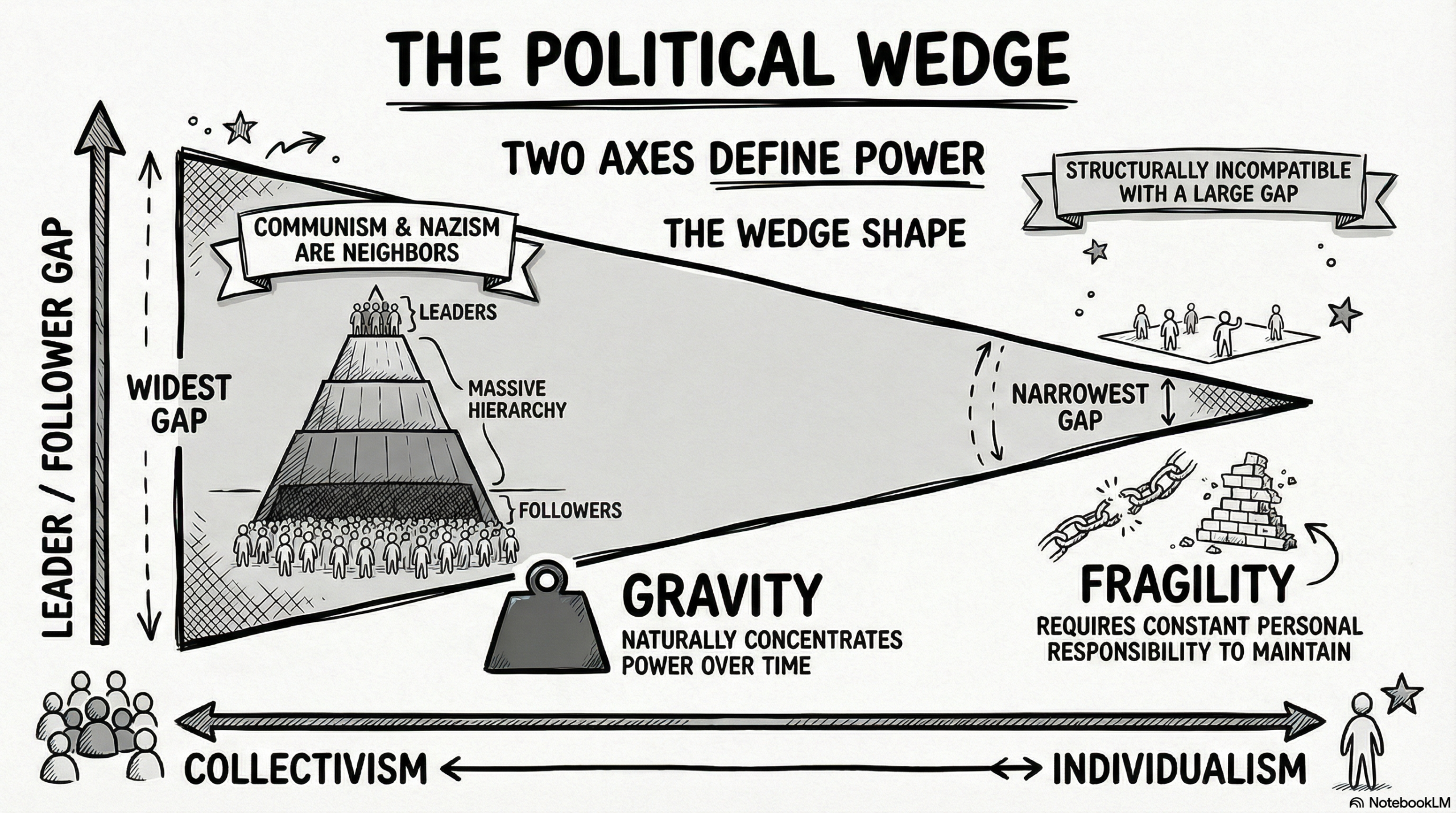
The horizontal axis runs from Collectivism on the left to Individualism on the right. This measures how much authority is centralized versus distributed. At the far Left, the state or collective controls nearly everything. At the far Right, the individual is sovereign and government is minimal or absent. This is the axis the conventional spectrum hides by placing two Collectivist systems at opposite ends.
The vertical axis runs from Leaders at the top to Followers at the bottom. Every society has leaders. The question isn’t whether leadership exists, it’s the size of the gap between those who direct and those who comply. A Communist Politburo has an enormous gap. A New England town meeting has a small one. Both have leaders. The gap is what matters.
Now here’s the key structural insight, the reason this model works where the standard spectrum doesn’t.
The Leader/Follower gap is not uniform across the horizontal axis. It is widest on the Collectivist side and narrows progressively (no pun intended) as you move toward Individualism. The spectrum is not a rectangle. It’s a wedge, wide on the Left, converging toward a point on the Right.
This has to be true, because Collectivism structurally requires hierarchy. Centralized control demands someone at the center doing the controlling and masses at the edges being controlled. The more Collectivist the system, the wider the gap must become to sustain it. You can’t run a command economy by committee.
Individualism is the opposite: structurally incompatible with a large Leader/Follower gap. A genuine Individualist leader cannot coerce followers without abandoning Individualism. The gap still exists, people aren’t equally engaged or informed, but it’s narrow, and its character is fundamentally different. Individualist leadership persuades. Collectivist leadership commands.
The shape is the argument. You don’t need to be told that Collectivism concentrates power. The wedge shows it. You don’t need to be told that Individualism resists hierarchy. The convergence proves it.
Gravity and Fragility
The wedge shape reveals something else, something that explains why the political landscape looks the way it does and why it keeps drifting in the same direction.
Collectivism has structural gravity. The mechanisms of centralized control — taxation, regulation, bureaucracy, media influence, educational authority — naturally concentrate power over time. Each expansion creates administrators who benefit from further expansion. Each generation inherits institutions slightly more entrenched than the last.
Think of it as building on a hillside. You don’t need an earthquake for the building to slide. The ground itself is inclined. You need constant reinforcement, deliberate engineering, and regular maintenance just to stay in place. Stop paying attention and gravity does the rest. That’s Collectivism. The danger isn’t a storm. It’s the terrain.
Individualism has the opposite problem: structural fragility. It requires continuous effort from individuals who must choose responsibility over comfort, self-reliance over dependence, and principle over personality. It cannot be delivered to passive recipients.
And that’s the paradox at the core of this entire framework: the moment Individualism becomes something a Leader provides to Followers, it has already become Collectivism wearing an Individualist Handle. You cannot give someone self-governance. They must take it, and keep taking it, or it isn’t real.
This asymmetry — gravity pulling left, fragility threatening the right — is the central tension of political life. It explains why free societies are rare, why they’re difficult to build, and why they must be actively maintained rather than passively enjoyed.
What Comes Next
So that’s the map. Two axes, a wedge shape, and an inherent gravitational pull toward the wide end.
But a map is only useful if you can find yourself on it, and if you’re willing to look honestly at where you actually stand versus where you think you stand.
Tomorrow, we walk the wedge. Every major political position gets placed on it, with its strengths acknowledged and its structural weaknesses exposed. No free passes. Including for the positions closest to my own.