
Part 2 of 2
Yesterday I laid out the Political Wedge, a two-dimensional spectrum with Collectivism and Individualism on the horizontal axis and the Leader/Follower gap on the vertical. The shape is a wedge because Collectivism structurally requires hierarchy while Individualism structurally resists it. If you missed it, read Part 1.
This week: where does everyone actually fall?
Ground rule before we start. Every position gets its strength acknowledged and its structural weakness exposed. The credibility of any framework depends on the person using it being willing to apply it honestly to their own tribe. So that’s what I’m going to do.
One more thing worth noticing before we begin. There are four distinct positions on the left side of this wedge and only three on the right. That’s not editorial bias, it’s the wedge working. The left side is wide, which means more room for structurally distinct positions. The right side narrows, which means fewer positions can exist there. The model predicts its own political geography.
The Left Side of the Wedge
Extreme Left: Communism, Nazism, and Totalitarianism
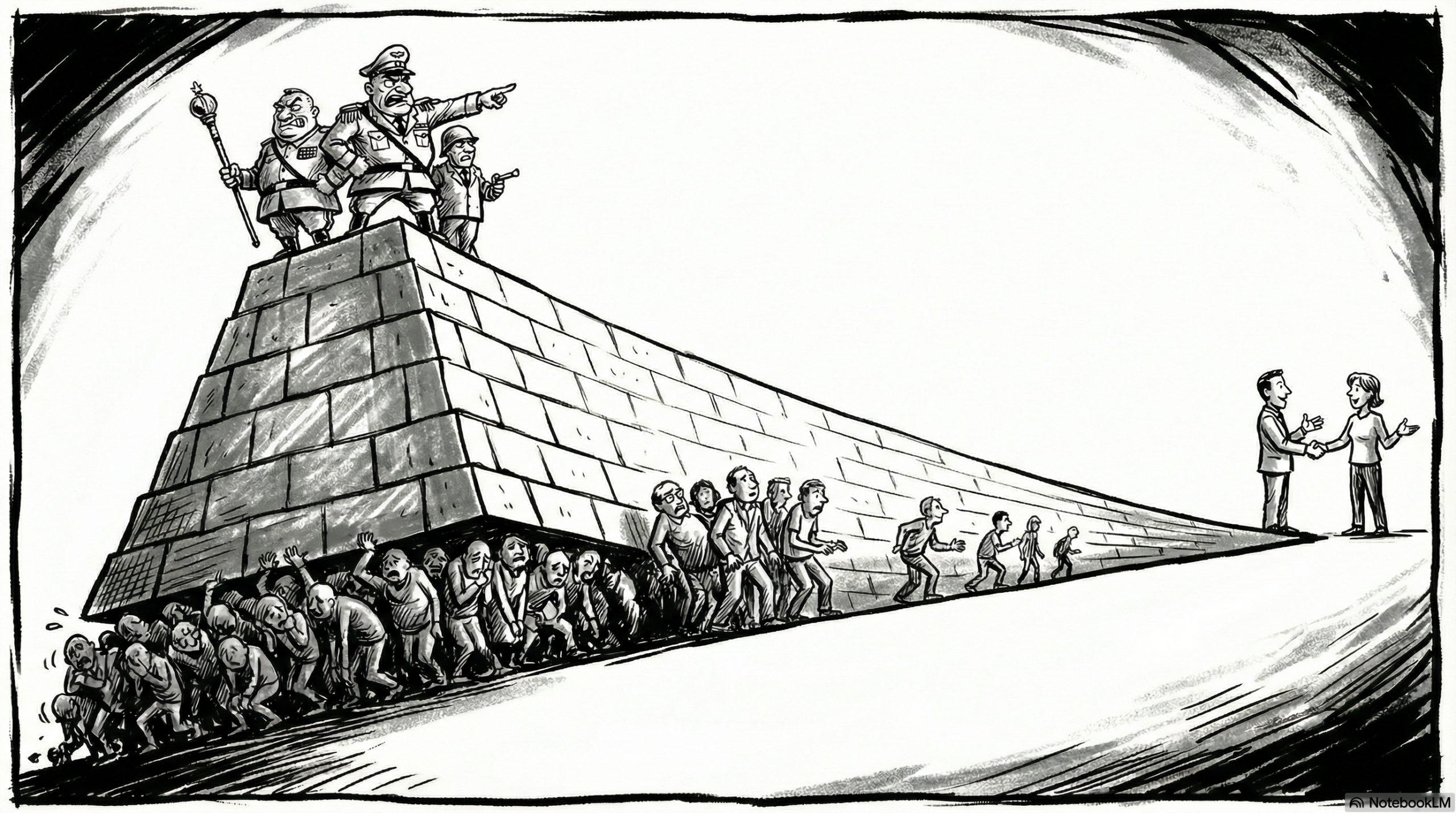
The widest point of the wedge. The Leader/Follower gap here is massive, a small ruling class exercises near-total control over economics, media, law, education, and daily life. Whether the system organizes around class, ethnicity, or raw state power, the structure is identical. Followers comply or are destroyed.
The stated goals vary by brand. Communism promises equality. Nazism promises national greatness. Every flavor of totalitarianism promises security. But the structural reality is the same in every case: extreme concentration of power among Leaders, with Followers reduced to instruments of the state.
Every Communist revolution in history has produced this outcome, not because the idealism was fake, but because the structure eats the idealism. Collectivism at this scale requires a ruling class, no matter what you call them or how sincerely you wish otherwise.
And Communism and Nazism are neighbors here, not opposites. The conventional spectrum’s placement of Nazism on the “far right” is one of the most successful examples of Handle theft in political history. Collectivists disowned their own ideological relatives by slapping an Individualist label on them. Nazi Germany nationalized major industry through direct control or coercive coordination. The individual existed to serve the Volk. That’s Collectivism. The label “far right” is the Handle. The mechanism is far left.
Far Left: Modern DNC Leadership
This is where the current Democratic Party leadership sits. And it’s uncomfortably close to the Extreme.
The defining feature is a large and growing Leader/Follower gap combined with increasing comfort with centralized control. This isn’t theory. Look at the receipts.
The embrace of transgender ideology as an unquestionable orthodoxy, where dissent isn’t just disagreed with but punished through professional and social destruction. The COVID-era overreaches, where governors and federal agencies assumed extraordinary powers over movement, commerce, speech, religion and medical decisions, and were visibly reluctant to give those powers back. The push for rampant, unfettered immigration, not just permissive policy, but active resistance to federal enforcement, with cities dedicating resources to obstructing lawful deportation while importing populations from violent and destabilized cultures with no meaningful vetting.
And then there’s Zohran Mamdani, a self-identified Democratic Socialist now running the largest city in America. His administration is stacked with Biden-era regulators, DSA members, and activists who openly advocate for the kinds of institutional capture that define the far left. He revoked the accepted definition of antisemitism on his first day in office. He appointed a former CAIR staffer to lead immigrant affairs specifically to resist federal immigration enforcement. This isn’t moderate governance. This is institutional power being consolidated and aimed.
The DNC’s Leader/Follower gap is significant. Followers are expected to adopt positions wholesale, on social policy, on economic questions, on cultural orthodoxies, with dissent treated as betrayal rather than disagreement. The leadership sets the agenda; the base is expected to comply. That’s a wide gap wearing a democratic Handle.
What separates them from the Extreme Left is institutional restraint: courts, elections, constitutional limits that still function. But the pattern of the last decade has been consistent erosion of respect for those restraints whenever they produce inconvenient results. They haven’t fallen into totalitarianism. But the structural gravity from Part 1 is pulling hard, and they’re not resisting. They’re leaning into it.
Moderate Left: Moderate Democrats
Here’s where it gets tragic.
Moderate Democrats sincerely believe that some degree of government involvement benefits the most people. Safety nets, public education, regulated markets, and are motivated by genuine care, not power hunger. These are good-faith political actors who believe in working within democratic institutions and who understand that compromise is how republics function.
Their structural weakness is the slope. The mechanisms they support — the agencies, the regulations, the programs — naturally concentrate power over time. It doesn’t take a crisis. The terrain is inclined. Moderate Collectivism slides toward authoritarian Collectivism because of gravity, not storms. And the effort required to prevent that slide rarely survives generational transitions.
But their more immediate problem is political. As the DNC leadership shifted toward the Far Left, moderate Democrats who pushed back were labeled traitors, centrists (used as a slur), or simply irrelevant. The party moved; they didn’t; and they’ve been left without a political home. The people most committed to democratic norms within the Democratic Party have been marginalized by their own institution.
This may be the most sympathetic group on the entire spectrum, sincere in principle, structurally vulnerable, and politically orphaned.
Marginally Left: Establishment Republicans
Here’s where this framework earns its keep, and where it’s going to make some Republicans very angry.
Establishment Republicans say the right words. Limited government. Fiscal responsibility. Individual liberty. They use these words constantly.
But watch what they do. Voting records that expand government when it’s politically convenient. Donor relationships with the same institutional powers they claim to restrain. An instinct to protect the party apparatus that overrides any principle the moment the two conflict. When forced to choose between Individualism and institutional power, they choose power. Consistently.
They’re moderate Collectivists wearing an Individualist Handle. Not because they’re secret liberals, but because their actual governing behavior prioritizes centralized institutional power over distributed individual liberty. On this wedge, they sit barely to the right of moderate Democrats.
And this reveals something important about the Republican Party itself. The GOP straddles the center of this spectrum, Establishment on the left side, Populists on the right. That internal tension isn’t a bug. It’s the wedge working. Two fundamentally different approaches share a party Handle, and the friction between them is the friction between Collectivism and Individualism playing out within a single institution.
Remember the neoconservative foreign policy problem from Part 1? Same dynamic. An interventionist approach — which is structurally Collectivist, centralizing military decision-making and committing the nation to open-ended engagements — wearing a Republican Handle. Bush’s wars didn’t break the Republican/Democrat pattern. They revealed that the pattern was never about parties. It was about the wedge.
The Right Side of the Wedge
The right side has fewer positions because the wedge narrows. There’s less room for variation in the Leader/Follower gap, which means fewer structurally distinct positions can exist here. That’s not a limitation of the model, it’s the model telling you something true about political reality.
Moderate Right: Populist Republicans and MAGA
Positioned further to the right than the Establishment is to the left, meaning the GOP’s center of gravity is on the Individualist side, but just barely, and only because the Populists are pulling it there.
The strength here is sincerity. Populist Republicans support limited government, economic freedom, national sovereignty, and resistance to institutional overreach not as talking points but as genuinely held convictions. The motivation is real. The results under Trump — deregulation, energy independence, confronting institutional corruption — reflect Individualist principles being applied, not just invoked.
But the structural weakness is real too, and it’s the one I have to name because it’s mine.
Too many Populist Followers want someone to deliver Individualism to them. A strong leader who will fight the system on their behalf. A champion who will dismantle the bureaucracy, drain the swamp, restore liberty, while they watch and cheer.
The Roman historian Sallust observed two thousand years ago: “Few men desire liberty; most men wish only for a just master.”
That’s not an insult aimed at someone else’s tribe. That’s my tribe’s weakness, and I’m naming it because the framework demands it.
The movement is vulnerable to personality-driven loyalty over principle. And personality-driven loyalty is itself a slide toward Collectivism, a widening of the Leader/Follower gap on the side of the spectrum where that gap is supposed to narrow. If your Individualism depends on a Leader providing it, you’ve already lost the principle. You’re holding a Handle.
The wedge predicts this. Even on the right side of the spectrum, the Leader/Follower gap doesn’t disappear. It narrows. And in that remaining gap lives the temptation to let someone else carry the weight of your own freedom.
Far Right: Libertarians
The strongest Individualist principles on the spectrum. Minimal government, maximum personal liberty, non-aggression principle. The Leader/Follower gap is narrow in theory, Libertarian philosophy is built on rejecting coercive hierarchy.
The weakness is practical. Many people attracted to the Handle of Individualism won’t bear its full costs. Genuine Individualism requires personal responsibility, self-reliance, and tolerance of outcomes that feel unfair. And Libertarianism faces its own paradox: political power requires collective application, which means the purest Individualists are the least equipped to organize politically. You can’t build a movement around “leave me alone” (Although, heaven knows they are trying. Bless their hearts.)
Extreme Right: Anarchism
The theoretical endpoint of Individualism. No state, no hierarchy, no coercive authority. The point of the wedge.
In practice, power vacuums don’t stay empty. Strip away institutional authority and informal power structures emerge, dominated by whoever has the most force, charisma, or resources. Anarchism doesn’t eliminate the Leader/Follower gap. It strips away the institutional checks that moderate it.
The result, historically and inevitably, is rapid collapse back toward Collectivism as strongmen and opportunists fill the void. The point of the wedge is where it breaks. Individualism pushed past sustainability collapses into the very thing it opposes.
The Map and the Cost
Every position on this wedge has a structural weakness. The Collectivist positions concentrate power despite good intentions. The Individualist positions struggle to sustain themselves because freedom is heavy and most people eventually want someone else to carry it.
The conventional spectrum hides all of this. It places two Collectivist systems at opposite “extremes,” makes moderate Collectivism look like the reasonable center, and gives Individualism no address at all. It’s a Handle masquerading as a map.
The wedge doesn’t tell you where to stand. It tells you what it costs to stand there, and what happens if you stop paying attention.
This framework is a Principle, not a Handle. You can test it. You can argue with it. You can break it if it’s wrong. What you can’t do is steal it, because it describes a mechanism, not a brand.
The Handle of “left vs. right” was stolen a long time ago. This is what it was supposed to be attached to.