Part 2 of 5
In 1798, an English clergyman named Thomas Malthus published An Essay on the Principle of Population and managed to be spectacularly wrong about nearly everything in it. His thesis was simple: human population grows faster than food production, so eventually everyone starves. His solution was equally simple: stop helping the poor. Charity, he argued, only encouraged the lower classes to breed, which made the problem worse. Nature would handle things if we’d just step aside and let the weak die off. He was wrong about the math (agricultural innovation has consistently outpaced population growth for over two centuries), wrong about the economics, and wrong about human ingenuity. But being wrong about everything didn’t stop his ideas from becoming enormously influential. It rarely does.
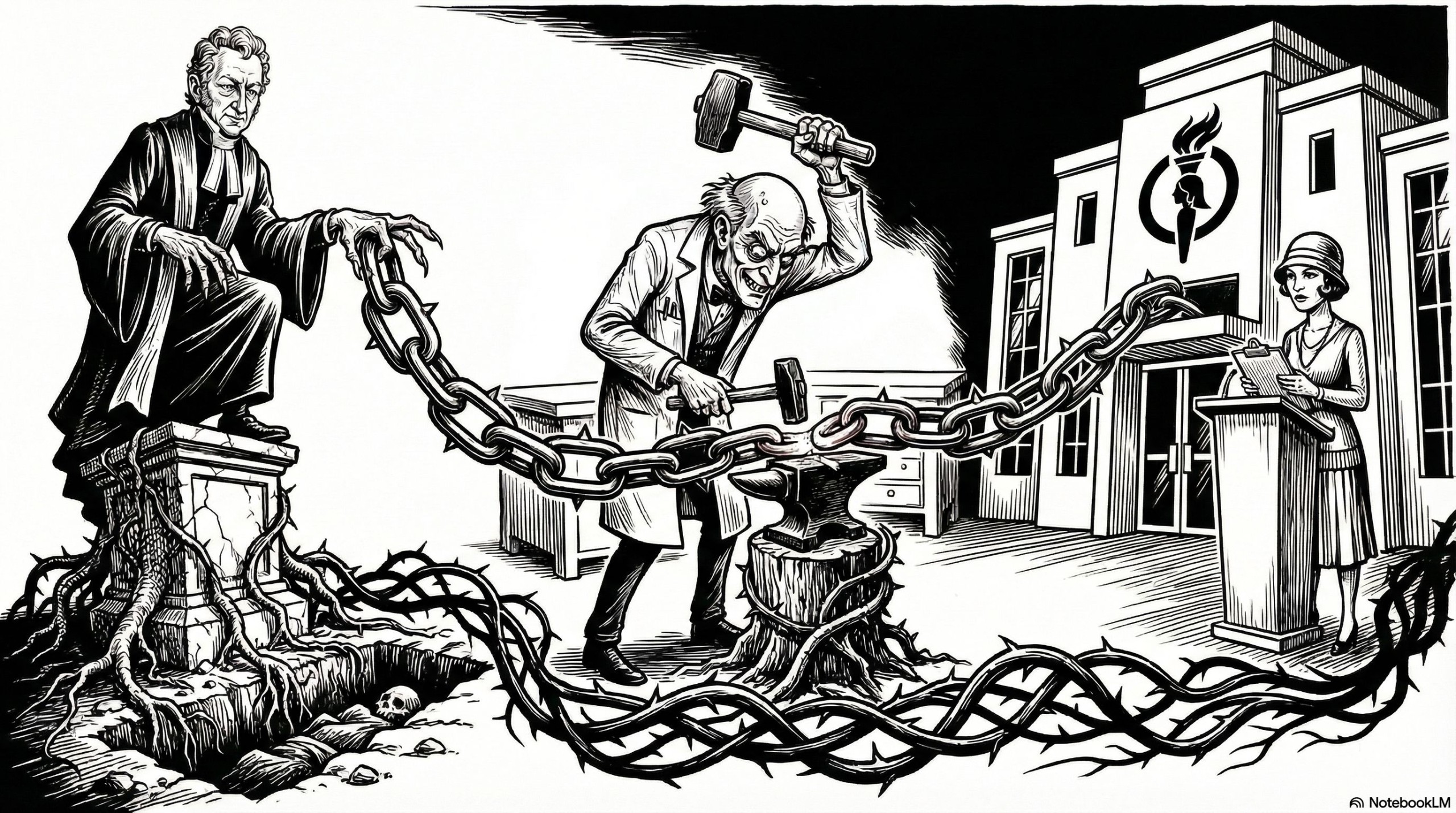
Malthus died in 1834. His ideas didn’t. Charles Darwin picked them up. Darwin’s cousin Francis Galton took them further, coining the term “eugenics” in 1883 (from the Greek for “well-born”). By the early 1900s, the eugenics movement had become a full-blown Progressive cause, funded by corporate foundations, promoted by intellectuals, and embraced by anyone who liked the idea of improving the human race by deciding which humans should be allowed to reproduce. It was Collectivism dressed in a lab coat.
Enter Margaret Sanger.
Sanger fled the United States in 1914 to avoid prosecution for distributing birth control literature. She landed in England, where she fell in with British Neo-Malthusians like Charles Vickery Drysdale, who were still carrying Malthus’s torch. She came back with a philosophy. Before settling on the term “birth control,” she considered naming her movement “Neo-Malthusianism.” (She chose the better branding. Give her that much.)
By the 1920s, Sanger was organizing international Neo-Malthusian conferences and building the American Birth Control League. She stacked her board with eugenicists, including Lothrop Stoddard, author of The Rising Tide of Color Against White World Supremacy. (Stoddard’s book became required reading in Nazi Germany. That’s the kind of company she kept.) Her magazine, The Birth Control Review, ran articles like “Some Moral Aspects of Eugenics” and “The Eugenic Value of Birth Control Propaganda.” This wasn’t a side interest. This was the foundation.
In May 1926, Sanger spoke to the women’s branch of the Ku Klux Klan in Silver Lake, New Jersey. She wrote about it openly in her 1938 autobiography: “Always to me any aroused group was a good group.” She was such a hit that she received a dozen invitations to speak to similar groups. (Imagine a Republican today explaining, “Any aroused group is a good group, so I spoke to the Klan.” How long would that career last?)
In 1939, Sanger launched the Negro Project, explicitly targeting Black communities in the South. In a letter to Clarence Gamble (heir to the Procter & Gamble fortune and a fellow eugenics enthusiast), she outlined a strategy of using Black ministers to promote birth control in their congregations, noting that she didn’t want “word to go out that we want to exterminate the Negro population.” Whether that sentence reveals her goal or merely her fear of how the project would be perceived, the surrounding context doesn’t help her case. The project’s own planning report described Black reproduction in the South as “careless and disastrous.” The American Birth Control League became the Planned Parenthood Federation of America in 1942.
That’s the root system. Malthus to eugenics to Sanger to Planned Parenthood. Every link in the chain is documented, published, and (until recently) openly celebrated. Planned Parenthood of Greater New York finally removed Sanger’s name from their Manhattan clinic in 2020, citing her “harmful connections to the eugenics movement.” Even they couldn’t keep the Handle on forever. But the organization she built on that eugenics foundation continues to be the largest abortion provider in the United States. The label changed (eugenics to birth control to reproductive rights to women’s rights). The function didn’t.
And the principle Sanger championed (that some Individuals simply don’t count, and the Collective gets to decide which ones) didn’t stop with the unborn. In 2005, a Florida court ordered a non-terminal woman named Terri Schiavo starved to death over thirteen days while her parents begged to take over her care. We’ll come back to her.
(If you’ve noticed a similar pattern in the current push for “Trans Rights,” where the Collective again overrides the Individual and the family to subject children to irreversible medical interventions, that’s not a coincidence either. But we’ll come back to that, too.)
Tomorrow, Part 3: The Legal Fiction.