Part 3 of 5
Norma McCorvey wanted an abortion. What she got was a pseudonym.
In 1970, McCorvey was pregnant with her third child in Texas, where abortion was illegal except to save the mother’s life. She was referred to two attorneys, Linda Coffee and Sarah Weddington, who needed a plaintiff for a federal challenge to Texas’s abortion law. They needed her name on the filing. They didn’t particularly need her.
McCorvey never attended a single hearing. She gave birth and placed the baby for adoption while the case crawled through the courts. When the Supreme Court issued its 7-2 ruling on January 22, 1973, she learned about it from the newspapers. Her own lawyers hadn’t bothered to call. When she later listed the important events of 1973 in her datebook, she included the Yom Kippur War, the Texas State Fair, and the closing of a local theater. She did not include Roe v. Wade.
The case that was supposed to be about her was never about her. She was a name on a filing (“Jane Roe”) and once the filing served its purpose, the woman behind the name became irrelevant. McCorvey later described her involvement in Roe as the biggest mistake of her life. In 2004, she filed a motion asking the Supreme Court to overturn the decision. The court dismissed it without hearing it. The woman the case was named for asked the court to undo it, and the court said no. Funny how that works, isn’t it?
But the exploitation of Norma McCorvey is only the surface-level fiction. The deeper one is in the legal reasoning itself.
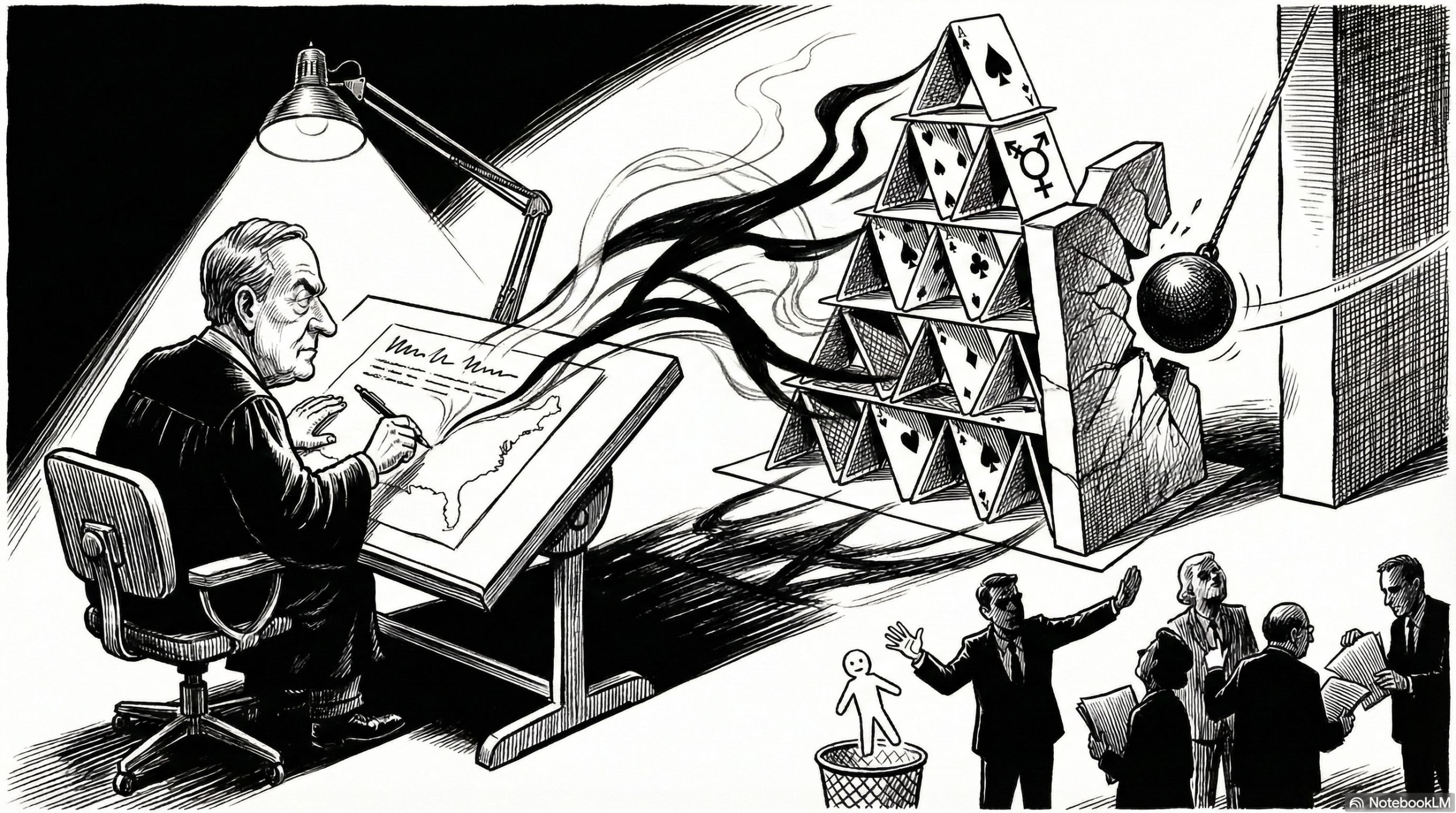
Roe v. Wade rests on Griswold v. Connecticut (1965), in which Justice William O. Douglas wrote that the Bill of Rights has “penumbras” (shadows) formed by “emanations” from its specific guarantees, and that these shadows contain a right to privacy. If that sounds like a man finding rights hiding behind other rights, that’s because it is. Douglas was building a constitutional principle from implications of implications.
Justice Harry Blackmun took Griswold’s shadow-rights and stretched them to cover abortion. His majority opinion in Roe created a trimester framework for regulating abortion that appears nowhere in the Constitution, nowhere in common law, and nowhere in the medical science of 1973. He manufactured it. The framework was so obviously legislative rather than judicial that even Justice Potter Stewart (who voted with the majority) called the lines “legislative.” Blackmun wasn’t interpreting law. He was writing it.
This is where the “living document” theory does its heaviest lifting. The idea goes like this: the Constitution can be amended, therefore it can also be reinterpreted to reflect evolving standards. It sounds reasonable until you think about it for ten seconds. A house has doors that pass through its walls. That doesn’t mean every wall can be removed. Some of them are load-bearing. The amendment process exists precisely because the Founders understood that certain structural walls hold the whole thing up. You don’t get to knock out a load-bearing wall just because the house has doorways.
But here’s where it gets revealing. The same people who insisted Roe was settled law (carved in stone, untouchable, beyond question) had no trouble treating other constitutional provisions as infinitely negotiable. The Second Amendment? Outdated, needs reinterpretation, doesn’t really mean what it says. The Supreme Court’s own rulings in the Scheidler RICO case? Lower courts ignored them repeatedly (but that’s Part 4). The “living document” only lives when it’s moving in the Collectivist direction. When it moves the other way, suddenly it’s frozen solid.
Even Ruth Bader Ginsburg (no one’s idea of a pro-life activist) criticized Roe’s reasoning. She said it was physician-centered rather than woman-centered. She warned that “doctrinal limbs too swiftly shaped may prove unstable.” She was right. The legal fiction held for forty-nine years, but it was always structurally unsound. It had to be. The Collectivist position on abortion requires legal fiction because observable reality (a distinct human life with its own DNA, its own heartbeat, its own trajectory) doesn’t cooperate. So you build your ruling on penumbras and emanations and trimester frameworks and hope nobody looks too closely at the foundation.
If you’ve noticed that the current push for “Trans Rights” requires its own set of legal fictions (compelled speech laws, the legal redefinition of biological sex, courts ordering people to affirm claims that contradict observable reality) the pattern should be getting familiar by now.
Tomorrow, Part 4: Racketeers for Life.