Part 5 of 5
In Part 2, I mentioned a woman named Terri Schiavo. Time to come back to her.
On February 25, 1990, Terri Schiavo suffered cardiac arrest in her Florida apartment. She was twenty-six. The resulting oxygen deprivation left her severely brain-damaged, and she was eventually diagnosed with a persistent vegetative state. She was not dying. She was not on a ventilator. She was breathing on her own. She received nutrition through a feeding tube.
For the first few years, her husband Michael and her parents worked together on her care. Then in 1998, Michael petitioned a court to remove her feeding tube. Her parents, Bob and Mary Schindler, fought him. They offered to take over her care entirely, at their own expense, for the rest of her life. The court said no. Over the next seven years the case generated fourteen appeals, five federal suits, and intervention by the Florida legislature, the governor, Congress, and the president. Her feeding tube was removed and reinserted twice before a judge ordered it removed for the final time on March 18, 2005. Terri Schiavo died thirteen days later. Starved to death while her parents begged to simply take their daughter home.
The principle Margaret Sanger championed (that some Individuals simply don’t count, and the Collective gets to decide which ones) didn’t stop at the unborn. A woman’s parents wanted to care for her. The system wouldn’t let them. The Individual didn’t count.
On June 24, 2022, the Supreme Court issued its ruling in Dobbs v. Jackson Women’s Health Organization and did something unremarkable: it applied rigorous legal analysis to Roe v. Wade. The legal fiction that had survived for forty-nine years on penumbras, emanations, and an invented trimester framework (see Part 3) collapsed the moment someone tested the foundation.
Dobbs did not ban abortion. It returned the question to the states, which is where the Constitution had always left it. But the reaction treated it as a nationwide ban, and the post-Dobbs ballot measures showed the logic-and-reason pattern one more time. Many used language that went far beyond what Roe ever established. Roe allowed states to restrict abortion after viability. Several post-Dobbs amendments enshrined protections with no meaningful gestational limit, or bundled abortion with unrelated issues (contraception, miscarriage care) so that voting against the amendment meant voting against things almost no one opposes. Ohio’s 2023 measure defined viability entirely by the treating physician’s judgment. New York’s 2024 amendment didn’t even use the word “abortion.” If the Collectivist position could survive honest language, they wouldn’t need to hide it inside other issues.
Through four articles now, I’ve dropped parenthetical notes about a similar pattern in the push for “Trans Rights.” Time to connect those dots.
The Collectivist Elite’s grip on the abortion issue started slipping well before Dobbs. By the time the Court overturned Roe, the replacement loyalty test was already built. “Trans Rights” requires followers to publicly deny observable biological reality in order to prove their loyalty. Once you’ve posted the hashtag and insisted that a man can become a woman by saying so, you’re in. The same two psychological doors from Part 1 apply. Either the movement is right, or you’ve been championing something monstrous being done to children. Canadian father Robert Hoogland was jailed for referring to his own child by biological sex. British women have been investigated by police for stating biological facts on social media. The machinery is the same. The paint is fresh.
But here’s what the Collectivist Elite keeps getting wrong.
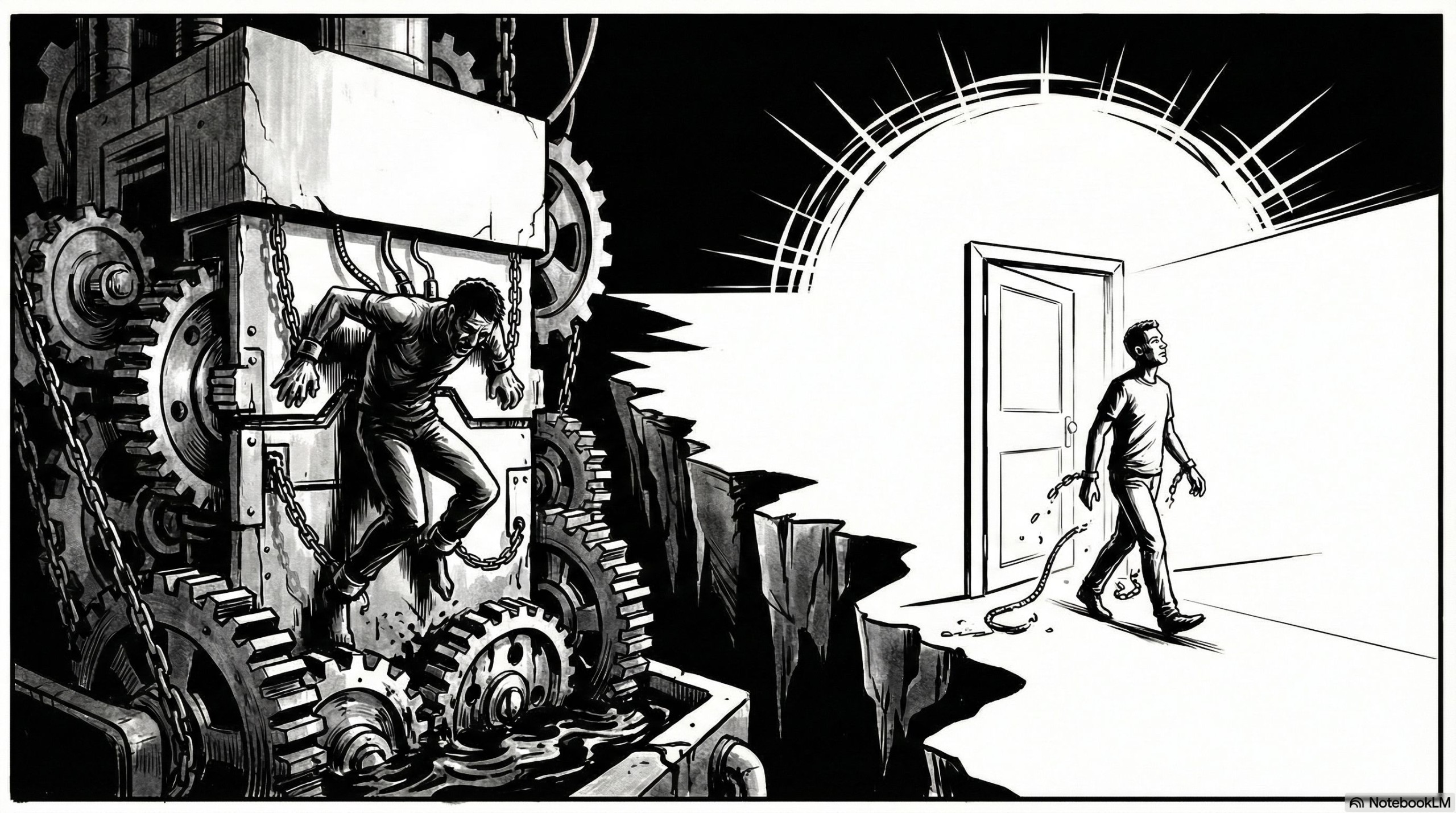
In Part 1, I described the mechanism totalitarian regimes use to purchase permanent loyalty: force someone to commit an atrocity (or to publicly champion one), and their psychological options collapse to two doors. Either the regime is justified, or they themselves are monsters. Most people choose door one and defend that choice forever.
There’s a third door. The Elite didn’t account for it, because the Elite (as a general rule) despises religion unless the religion involves worshipping them. The third door is forgiveness.
In Pailin, a province in western Cambodia established as the last Khmer Rouge stronghold, there are twenty-two Christian churches in a town that is basically one road off a national highway. Cambodia is ninety-five percent Buddhist. But when Christian missionaries arrived in the border provinces after the regime collapsed, they found willing listeners among the former Khmer Rouge, and the conversions weren’t scattered. They were wholesale. Former soldiers, former commanders, former district secretaries. A man who ran propaganda radio for Pol Pot now hosts a Christian program called New Signs, broadcasting across Cambodia. His audience is still mostly former Khmer Rouge. A single Cambodian-American pastor named Christopher LaPel personally baptized multiple senior regime figures, including Nuon Chea (Brother Number Two, the regime’s second-in-command). Former platoon commanders are now pastors with their own churches.
LaPel’s own parents, brother, and sister had all been killed by the Khmer Rouge. That didn’t stop him from going back. Among the people he baptized was a man hiding under the name Hang Pin, who said he’d been a schoolteacher. In 1999, LaPel found out who Hang Pin actually was: Comrade Duch (Kaing Guek Eav), who had directed the Tuol Sleng prison where at least fourteen thousand people were tortured and killed. LaPel’s response was not what the Collectivist playbook would predict. He looked the man whose regime killed his family in the eye and said, “I love you and I forgive you.” He later testified at Duch’s war crimes tribunal (not for leniency, but to testify to the power of God to transform a sinner). He visited Duch in prison for years afterward. They read the Bible together.
The blood-cement mechanism from Part 1 only works if there are two doors. Christianity opens a third. You are a monster and you can be forgiven. You don’t have to defend the regime to preserve your sanity. You can face what you did, and survive it, because the weight is carried by someone else.
The Collectivist Elite consistently overlooks this. They model human behavior as a system of incentives and pressures, and within that model the loyalty trap has no exit. But it does. The exit has been there for two thousand years, and it keeps working on exactly the people the Elite thought they owned forever.
Every stage of abortion’s history in America has required people to abandon logic and reason to maintain the Collectivist position. From Sanger’s eugenics to Roe’s legal fiction, from twenty-eight years of RICO abuse to post-Dobbs deception, the pattern repeats because it has to.
But the trap has a door the architects didn’t build. And it’s unlocked.