Your bathtub is dirty. You know it’s dirty. Every time you step in you notice it, and every time you step out you think,
I really need to clean that.
You don’t clean it.
Not because you’re lazy (although, sure, maybe a little). Not because you don’t care. You don’t clean it because the math doesn’t work yet.
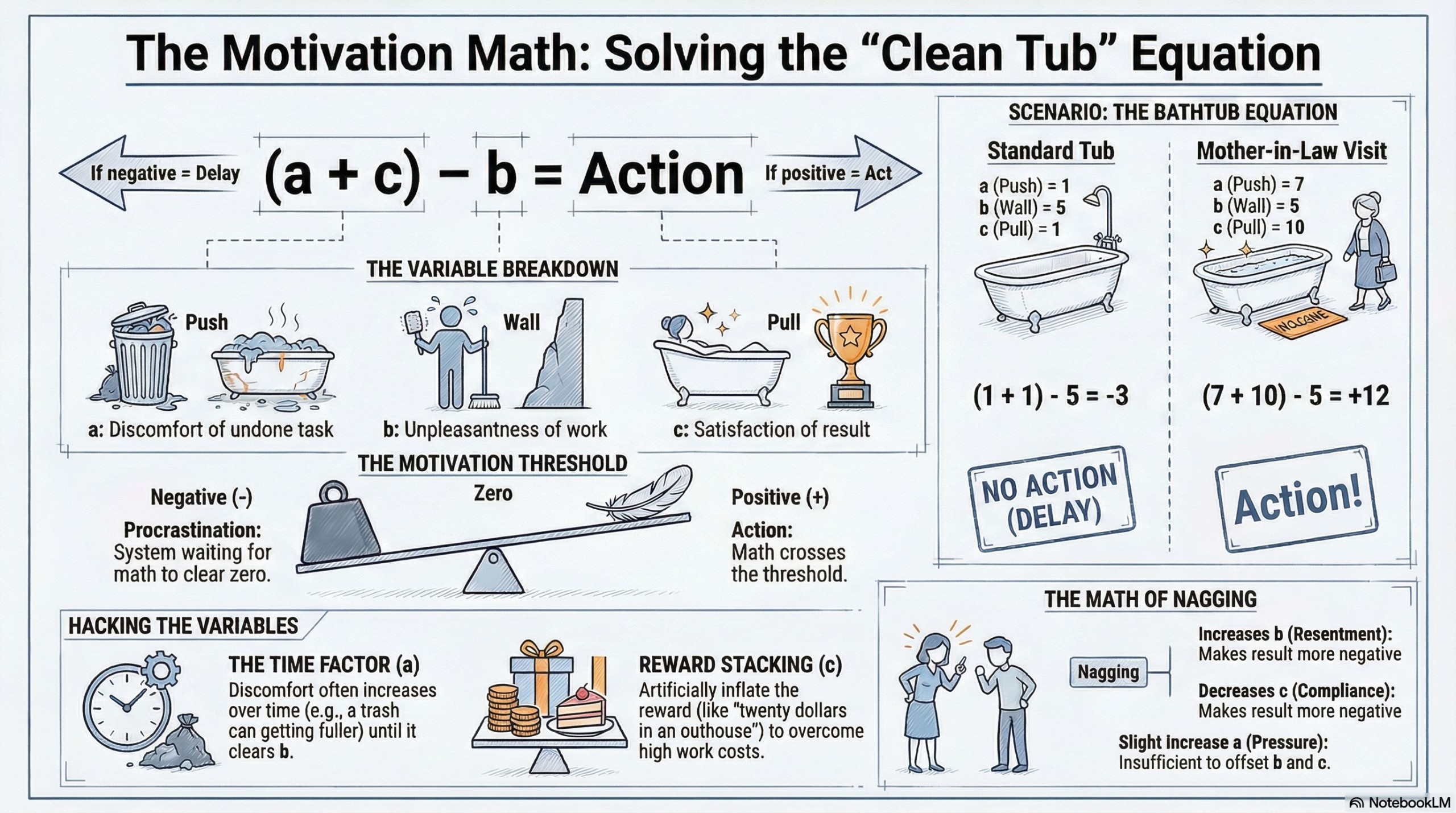
The dirty tub bothers you, but not that much. A one on a scale of ten, let’s say. And when it’s clean, that’s nice, but again, you’re not going to stand there admiring it. Another one. But the actual work of scrubbing the tub? Getting on your knees, the chemicals, the wet clothes, the sore back? That’s a five. Maybe higher.
So you’ve got a small push from the dirty tub, a small pull from the idea of a clean tub, and a much bigger wall between you and the act of cleaning. The wall wins. You step out of the shower, think I really need to clean that, and go on with your day.
Now change the numbers. Your mother-in-law is coming to visit. Suddenly the dirty tub isn’t a one. It’s a seven. And a sparkling clean bathroom when she arrives? That’s a ten. The work hasn’t changed (still a five), but the push and the pull just overwhelmed the wall. You clean the tub.
You didn’t become a different person. You didn’t develop discipline or have a breakthrough. The numbers shifted.
That’s it. That’s the whole engine of human motivation.
The Equation
Here’s what’s actually happening, stripped down to its bones. Every task you face involves three emotional values:
a — how much the undone task bothers you
b — how unpleasant the work is
c — how good the finished result feels
All positive numbers. All representing intensity. The equation is simple:
(a + c) − b
If the result is positive, you’ll do it. If it’s negative, you won’t. Not because of laziness or character. Because the math doesn’t compute.
The dirty tub example, first pass: a = 1, c = 1, b = 5. The equation gives you negative three. You’re not cleaning that tub. Second pass (mother-in-law inbound): a = 7, c = 10, b = 5. Now you’re at positive twelve. You’re already reaching for the scrub brush.
The Trash Can Problem
Your kitchen trash can is getting full. You know you should empty it. You don’t. It gets fuller. Still don’t. It gets to the point where you’re balancing things on top like some kind of garbage Jenga, and then you empty it.
What changed? Not the work. Carrying the bag out takes the same effort whether it’s half full or overflowing. Not the satisfaction of a clean can (that stays about the same too). What changed is how much the full trash can bothered you. That value climbed, day by day, until it overwhelmed the cost of the work.
The equation isn’t static. It runs on a clock.
The value of a (discomfort from the undone task) often increases over time. The trash gets fuller. The mess spreads. The guilt compounds. Meanwhile b (the work) stays roughly the same, and c (the satisfaction) stays roughly the same. So what you’re really waiting for is a threshold crossing: the precise moment the rising discomfort tips the equation from negative to positive.
Procrastination isn’t a character flaw. It’s the system waiting for the math to work.
This also explains why some tasks never get done. If a doesn’t climb (the thing doesn’t bother you more over time) and b is high enough, the equation never crosses zero. That filing cabinet you’ve been meaning to organize for three years? The discomfort of it being disorganized hasn’t increased. The work required hasn’t decreased. The math has never cleared, and it probably never will (unless someone gives you a reason).
Twenty Dollars in an Outhouse
There’s an old joke. A man finishes his business in an outhouse and as he stands up, a dollar slips from his pocket and falls into the hole. He stares down at it. Then he pulls out his wallet, takes out a twenty-dollar bill, and drops that in too.
The other man in the outhouse stares at him. “Why in the world did you do that?!?”
“You don’t think I’d climb down there just for a dollar, do you?”
The man couldn’t change a (the dollar was already down there). He couldn’t change b (the horrific task of climbing down is what it is). So he artificially inflated c until the equation cleared. He engineered his own motivation by making the reward large enough to overwhelm the cost.
People do this all the time without realizing it. Pair a podcast with a dreaded chore. Promise yourself a coffee shop visit after filing taxes. Open a beer after mowing the lawn. These are all twenty-dollar strategies. You’re not changing the task. You’re not changing the discomfort. You’re stacking the reward until the math works.
The equation doesn’t care why c is high. Only that it is.
When the Equations Compete
You’re hungry. You know you need to lose weight. These two facts are running separate equations in your head at the same time, and they’re fighting each other.
Equation one (eat now): the discomfort of hunger is climbing. Eating is easy and immediately satisfying. The math is heavily positive and getting more positive by the minute.
Equation two (don’t eat): being overweight carries its own discomfort. Resisting food costs effort. The payoff (being healthier, lighter, more energetic) is real but distant and abstract.
As long as equation two is stronger than equation one, you hold. The moment it isn’t, you eat. And equation one has a structural advantage: hunger compounds with time. The discomfort grows. Meanwhile, the discomfort of being overweight stays about the same from minute to minute. It doesn’t intensify the way hunger does.
This is why “just remember why you’re dieting” is bad advice. It’s holding a fixed value against a rising one. The rising one eventually wins. Always.
Better strategies change the structure. Eating smaller meals more frequently bleeds off the rising hunger value before it overpowers the diet equation. Keeping junk food out of the house increases b on the “eat junk” equation (now you have to drive somewhere to get it). Visible progress tracking increases c on the diet equation by making the abstract payoff feel concrete and immediate.
You’re not fighting willpower. You’re adjusting variables.
The Enjoyable Destruction Problem
The tub, the trash, the filing cabinet — those are all cases where the action is unpleasant but beneficial. Addiction flips the whole thing.
When the action is enjoyable but destructive, a new variable shows up: d — the long-term damage or consequence of the action. Drinking, scrolling, gambling, overeating. The act itself has high c (pleasure), low b (it’s easy to do), and an a that grows — not as discomfort from an undone task, but as craving intensity. The craving builds the longer you resist.
Resistance holds when d (the damage) outweighs everything else. But here’s the structural problem: d is abstract and distant. It doesn’t intensify. Meanwhile the craving (a) keeps climbing. You’re holding a wall steady against a rising flood.
At the moment when the choice between momentary pleasure and long-term good presents itself, it seems unfair that momentary pleasure always has the home-field advantage.
This is why abstinence strategies that rely on “remember how bad it is for you” tend to lose in the long run. They’re trying to hold d constant against a rising a. Eventually, a wins.
The strategies that actually work change the equation’s structure. Accountability partners and visible tracking make d feel more immediate (it’s not abstract when someone is watching). Substitution and distraction bleed off a before it overpowers everything. Breaking the accumulation cycle (changing routines, avoiding triggers) keeps a from climbing as fast.
The lure of a destructive pleasure seems to grow with time. That’s not weakness. It’s a doing exactly what a does.
Why Nagging Backfires (The Math)
This is where the equation gets interesting, because it explains something everyone has experienced and almost nobody talks about honestly.
Someone in your household won’t clean the tub. Their equation comes out negative. The work is too high, the discomfort of a dirty tub is too low, and the satisfaction of a clean tub doesn’t move the needle enough. So you nag.
Nagging does three things to the equation simultaneously.
First, it bumps up a slightly. The undone task now carries social pressure on top of its inherent discomfort. Not a huge increase, but it’s there.
Second, it increases b significantly. The work no longer feels like a choice. It feels like compliance. Autonomy is gone. Resentment loads onto every scrub stroke. The task that was a five is now an eight.
Third, it actually decreases c. Finishing the task no longer feels like accomplishment. It feels like giving in. The satisfaction that might have been a three drops to a one.
Run the math. The slight increase to a gets overwhelmed by the large increase to b and the decrease to c. The equation is now more negative than it was before. Nagging mathematically reduces the likelihood of the task getting done.
It’s not just ineffective. It’s counterproductive.
And here’s the part nobody wants to say out loud: when nagging goes on long enough, the equation starts producing a different answer entirely. The system recognizes that eliminating the nagger would reset b and c to baseline, which is a bigger improvement than completing the task ever was. The brain starts treating the relationship as the problem to solve, not the tub.
That’s not spite. That’s the equation running correctly on corrupted inputs.
The Praise Inversion
If nagging poisons the equation from two directions while barely helping from one, praise does the opposite.
Praise for completed work decreases b. The work becomes associated with a positive social outcome rather than drudgery. When you know someone will notice and appreciate the effort, the task itself carries less emotional weight. It’s still work, but it’s lighter.
Praise also increases c significantly. Now the satisfaction of a finished task includes social reward on top of the task-level satisfaction. A clean tub doesn’t just feel clean. It feels recognized.
Both adjustments push the equation positive. Nagging attacks from two directions with a token assist from one. Praise helps from two directions with no downside.
This works both ways, and the direction that gets ignored most is the one that matters most.
The person in the household who already cleans the tub (whose equation already runs positive because their a and c are naturally higher) still benefits from praise. Their c was already high enough to motivate the action, but praise stacks on top of it. It reinforces the pattern. And more importantly, it short-circuits the resentment that builds when effort consistently goes unnoticed.
I’ll put it bluntly. When a husband vocalizes appreciation for his wife’s work around the house, it increases her c (which was already running positive). That increased c makes the ongoing effort sustainable. And a wife who feels appreciated doesn’t need to nag, because the resentment that drives nagging never builds in the first place.
Praise prevents nagging. Nagging prevents action. If you want the tub cleaned, start with the math.
The Equation You’re Already Running
You don’t need to memorize a formula to use this. You’re already running it. Every decision you avoid, every task you delay, every habit you can’t break, every chore you resent — the Clean Tub Equation is running underneath all of it.
The value isn’t in knowing it exists. The value is in knowing you can change the variables.
You can throw twenty dollars down the hole. You can structure your environment so b drops and c climbs. You can stop nagging the people around you and start recognizing the work they do. You can stop beating yourself up for procrastinating and start asking which variable needs to move.
And if you’re on the receiving end? If someone in your life keeps asking why you won’t just clean the tub?
Now you can show them the math.