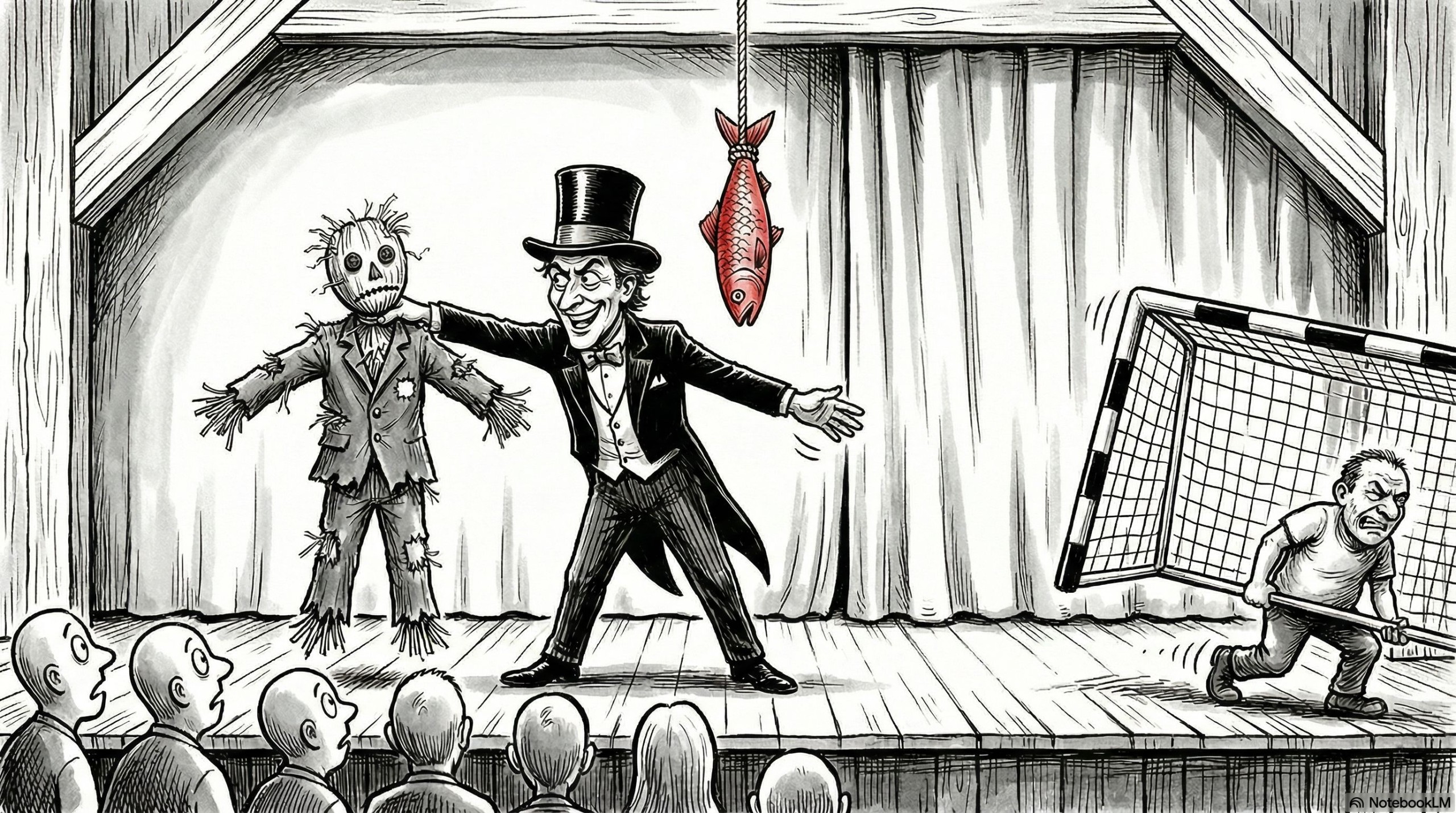
Ronald Reagan loved telling Soviet jokes. One of his favorites went like this: An American and a Soviet citizen were comparing their countries. “We have freedom in the US,” the American said. “I can walk right up to the White House and shout ‘Reagan sucks!’ and no one will stop me.” “We have the same freedom,” the Soviet replied. “I can walk right up to the Kremlin and shout ‘Reagan sucks!’ and no one will stop me either.”
Reagan told that joke to Gorbachev’s face at the Iceland summit. He told it to audiences for years. The punchline works because the Soviet citizen technically said something true while completely dodging the actual point. That’s misdirection. And if you watched any coverage of the No Kings protests, you saw it everywhere.
Fallacies of Misdirection are arguments that dodge the real point. They might sound like a response, but the actual argument has been quietly swapped for something else. These are the most common fallacies in political debate because they’re the easiest to pull off. You don’t need a counter-argument. You just need to make the real argument disappear.
Straw Man — distorting someone’s position into something easier to attack.
Your neighbor says the city shouldn’t spend $50 million on a new stadium while the roads are falling apart. At the next council meeting the mayor tells everyone your neighbor “hates sports and wants to kill youth athletics.” Now your neighbor is defending something he never said, and nobody’s talking about the roads.
The No Kings protesters didn’t argue that Trump’s tariff policy was wrong, or that the Iran war was unjustified. Those require evidence. Instead they called him a fascist dictator (while freely protesting in 3,300 locations, on every network, with governors issuing statements of support). A Trump voter at the St. Paul rally told PBS the obvious: “It’s perfectly safe to go out there and call Trump all the horrible names you want to call him, because he is not, in fact, a dictator.” When reporters actually asked protesters what they meant, most couldn’t explain it. Building a Straw Man is easier than building an argument.
Is it a Straw Man? He said the border needs more security. You say he wants to “put kids in cages.” Yes. He said the border needs more security. You say border security won’t fix visa overstays. No — that’s a counter-argument. That’s just debate.
Red Herring — introducing an irrelevant topic to divert attention from the actual argument.
You’re losing a debate about the speed limit on your street, so you bring up the fact that the other guy got a DUI in college. Has nothing to do with whether the speed limit should change, but now everyone’s talking about the DUI.
The No Kings protests started as anti-authoritarianism. By March 2026, the Newark rally demanded: impeach Trump, abolish ICE, release all Epstein files, end the Iran war, raise the minimum wage to $20 an hour, restore all DOGE cuts, rehire every fired federal worker, and impeach Justices Thomas and Alito. A $20 minimum wage is not an anti-tyranny position. It’s a policy preference smuggled under an anti-authoritarian banner to borrow moral weight it hadn’t earned. When you protest everything, you address nothing.
Is it a Red Herring? Someone argues against school vouchers by bringing up a teacher’s divorce. Yes — irrelevant to the policy. Someone argues against school vouchers by citing test score data from voucher programs. No — that’s relevant evidence.
Tu Quoque — deflecting criticism by pointing at someone else instead of answering the charge. Latin for “you too.”
Your teenager gets caught skipping school. His defense: “But Jake skips all the time and you never say anything!” Whether Jake skips or not doesn’t change the fact that your kid skipped. He hasn’t answered the charge. He’s just pointed somewhere else.
The No Kings protesters screamed about executive overreach. Where were they when Biden’s vaccine mandate covering 80 million workers got struck down by the Supreme Court? Where were they when his student loan order got struck down too? No “No Kings” marches. No “dictator” signs. The overreach was fine when their guy did it. Both sides play this game (some Establishment Republicans deflect criticism by pointing to Obama rather than defending the current policy on its merits). But the left’s version right now is brazen because the courts already ruled that Biden overreached. They didn’t care then.
Is it Tu Quoque? “You criticize my spending but you bought a boat last year!” Yes — deflection, not defense. “You criticize my spending, and here’s my budget showing I’m under projection.” No — that’s answering the charge directly.
Moving the Goalposts — changing the criteria after they’ve been met.
Your boss says you need to close ten deals to get the promotion. You close ten. Now he says you also need to bring in a new client. You do that. Now it’s a “culture fit” issue. The target was never real.
The original No Kings grievance was specific: Trump joked about being a “dictator for a day,” posted AI-generated videos of himself in a crown, and held a military parade on his birthday. By March 2026, “acting like a king” had expanded to cover tariffs, immigration enforcement, the Iran war, budget cuts, and workforce reductions. Those aren’t evidence of tyranny. They’re policy disagreements. The definition of “king” moved from “claims dictatorial power” to “does things we disagree with.” That’s not protest. That’s a vocabulary trick.
Is it Moving the Goalposts? The standard for “safe” keeps changing every time you meet it. Yes. New evidence emerged that genuinely changes what counts as adequate. No — updating standards based on new data is just honest reasoning.
Special Pleading — applying rules to everyone else while claiming an exception for yourself.
A parent grounds their kid for lying, then tells an obvious lie right in front of them. The kid calls it out. The parent says “That’s different. I’m an adult.” Same rule, selectively enforced.
The 2020 BLM riots caused up to $2 billion in property damage, at least 25 deaths, and over 2,000 injured police officers. The vast majority of charges were dismissed. Then-Senator Harris promoted a bail fund that released people charged with murder and sexual assault. Compare that to January 6: defendants on non-violent charges held for months or years pretrial, some in solitary. Senator Rand Paul documented defendants held nearly a year without trial. Burn down a city block for our cause and it’s free speech. Walk through the Capitol for the other cause and you lose your due process rights. Rules that only bind your opponents aren’t rules. They’re weapons.
Is it Special Pleading? “Protests are free speech when we do it, insurrection when they do it.” Yes. “These two situations differ because one involved property damage and the other targeted a government proceeding.” No — that’s a real distinction, even if you disagree with the conclusion.
Every fallacy in this article does the same thing: it makes the real argument disappear. And at one of the No Kings rallies, a protester let the game slip. She told a reporter she was there to “open up communication.” A protest leader scolded her and told her not to talk to conservatives.
Ask a conservative at a tax protest why they’re there, and you get a specific answer in ten seconds. “I don’t like paying a third of my income in taxes and watching the government waste it.” Nobody told them to say that. They thought about it.
Ask a No Kings protester, and you get hemming and hawing and eventually “I don’t like answering questions.” Somebody else did their thinking for them (and didn’t do a very good job of it).
Political ideologies that depend on blind obedience don’t just tolerate logical fallacies. They need them. If the Followers start thinking clearly, they might stop following.