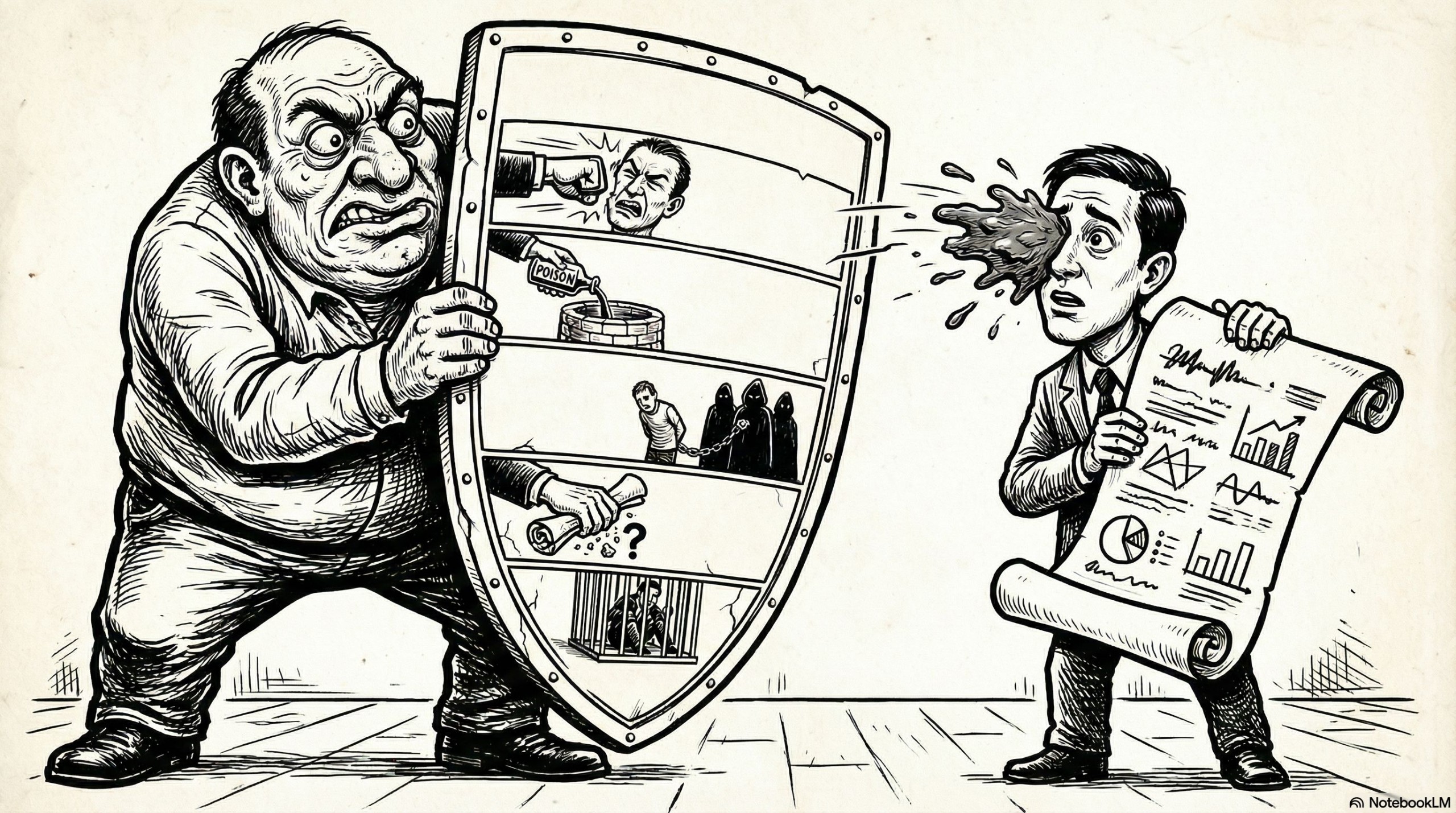
There’s a difference between an insult and a logical fallacy.
When Donald Trump Jr. stood at a Saudi business summit in October 2025 and called No Kings protesters “older and fatter,” that was mockery. The room already agreed with him. Nobody in Riyadh was deciding whether American protesters had a point. He was playing to a friendly crowd. Rude, sure. Not a fallacy.
When mainstream outlets spend a news cycle calling a president “fascist,” “racist,” and “mentally defective” to millions of voters still forming opinions, that’s something else. The audience can be influenced. The label can replace the argument. And if the label sticks, the argument never has to be engaged at all.
That’s what separates the fallacies in this article from schoolyard name-calling. A personal attack only works as a logical fallacy when it targets someone in front of an audience that could have been persuaded by their argument. No audience, no fallacy. Just rudeness.
That’s today’s category. In Parts 1, 2, 3, and 4 we covered fallacies that dodge the point, rig the question, cook the books, and substitute pressure for proof. Those at least pretend to be about the argument. Today’s fallacies drop the pretense. They’re about you.
Ad Hominem — attacking the person making the argument instead of the argument itself, in front of an audience whose opinion matters.
Your coworker presents data showing the project is behind schedule. Instead of questioning the data, your boss tells the room, “He’s only been here six months. What does he know?” Now the room isn’t thinking about the data. They’re thinking about his résumé.
During the 2024 campaign and into 2026, mainstream outlets routinely described Trump as a fascist, a racist, an authoritarian, and (in the Daily Beast’s contribution) a “corrupt, racist, misogynist, mentally defective would-be king.” Those descriptions were published to general audiences: voters, undecided moderates, people forming opinions. Not one of those labels addresses a tariff rate, an immigration policy, or a war strategy. They exist to make the audience stop listening to the man before evaluating what the man is actually saying. If the tariff rate is wrong, show the math. “Mentally defective” is not math.
From the right, Trump’s press conference language does the same thing when it’s aimed past the rally crowd at the broader public. Calling protesters “radical left lunatics” from the White House podium isn’t banter among friends. It’s broadcast to every newsroom in the country. The goal is the same: make persuadable viewers dismiss eight million people without hearing what they actually came to say.
Is it Ad Hominem? “You support border security? You’re a racist.” Yes — attacks the person, not the position. “You support border security, but the data shows most undocumented entry comes through visa overstays, not the southern border.” No — that engages the argument.
Poisoning the Well — preemptively discrediting someone so that anything they say afterward gets filtered through the smear.
Before a meeting, your manager tells the room, “Just so you know, Dave has been pretty negative lately.” Now every point Dave makes gets heard through “negativity” before anyone evaluates it on merit. The well was poisoned before Dave opened his mouth.
The term “Christian Nationalist” has been deployed this way in mainstream publications for the past several years. The label bundles anyone who votes from a religiously informed worldview with theocratic extremists who want to replace the Constitution with Leviticus. Once the label lands, an evangelical who says “I think life begins at conception” isn’t a citizen with a moral argument. He’s a Christian Nationalist. The label does the work. His argument never gets heard on its own terms. That’s the whole point.
Is it Poisoning the Well? A columnist labels a group “extremists” in the headline, then presents their policy argument in the body text. Yes — the label filters everything that follows. An article notes a group’s funding sources alongside a fair presentation of their argument. No — that’s relevant context, not a substitute for engagement.
Guilt by Association — discrediting an argument because of who else holds it.
“You agree with Dave on the budget? Dave also thinks we should fire half the team.” Dave’s budget analysis doesn’t get worse because he has a separate bad idea.
At the March 28 rally in West Palm Beach, some counter-protesters wore Proud Boys gear. In Los Angeles, the Department of Homeland Security described “1,000 rioters” at the Roybal Federal Building. Both incidents were used to characterize the broader movement. Proud Boys caps in one Florida parking lot get stretched to cover eight million people in all fifty states. Bottles thrown at one building in LA become the story of a nationwide day of peaceful protest. The overwhelming majority of demonstrators stood on sidewalks holding signs. Their arguments about the Iran war, ICE enforcement, and executive overreach don’t change because somebody three states away threw a rock.
Is it Guilt by Association? “Hitler was a vegetarian, so vegetarianism is suspect.” Yes — Hitler’s diet says nothing about vegetables. “This organization shares board members and direct funding with a convicted fraud operation.” No — that’s a material connection, not coincidental overlap.
Genetic Fallacy — dismissing an argument because of where it came from rather than what it says.
“That idea came from the intern who got fired last month. Can’t be worth much.” The idea is either good or it isn’t. Its origin doesn’t change its merits.
“That’s a CNN talking point.” You hear this constantly, and sometimes it’s accurate (CNN does have talking points). But even CNN occasionally reports something true. If a CNN segment claims federal spending increased 12% last quarter and you can verify the number through the Treasury Department, the number is right regardless of which channel aired it first. “That’s an MSNBC position” and “That’s a Fox News talking point” do the same work from opposite sides: they let the listener skip the evidence and reject the source label instead. If the data is wrong, show that the data is wrong. Where it was published is not the same as whether it’s true.
“That policy came from Bernie Sanders, so it’s socialism.” Maybe. Or maybe this specific proposal has merit on the numbers and you’d need to actually check. “That study was published by the Heritage Foundation, so we can ignore it.” You can note the source and check the methodology. Those are different things.
Is it a Genetic Fallacy? “That argument came from Fox News, so it’s wrong.” Yes — the specific claim needs its own evaluation regardless of the channel. “That study’s methodology was criticized by three independent peer reviews.” No — that evaluates the argument itself.
Kafkatrap — framing any denial of an accusation as proof of the accusation.
Your partner says you never listen. You cite three recent examples of listening. Your partner says, “See? You’re doing it right now — not listening to what I’m telling you.” There is no response that isn’t used against you.
Robin DiAngelo’s White Fragility (2018) is the textbook case. The structure: all white people are racist because of systemic whiteness. If you agree, you’ve confirmed the theory. If you disagree, your disagreement is “white fragility” (a defense mechanism protecting your racism), which confirms the theory. If you stay silent, silence is complicity. If you leave the room, that’s avoidance. Every response is proof of guilt. Columbia professor John McWhorter called the whole framework “dehumanizing condescension.” The book was adopted as required reading by corporations, military branches, and churches. Millions of Americans were trained to treat an unfalsifiable accusation as established fact.
The No Kings movement runs a softer version. “Silence is violence” has the same architecture: speak up and you’re performing allyship (suspect), stay silent and you’re complicit (guilty), push back and you’re proving the problem exists. The accusation is built so that no response clears you.
Is it a Kafkatrap? “If you deny being racist, that proves you’re racist.” Yes — no possible response clears you. “Your actions over the past year show a pattern of documented racial bias, and here’s the evidence.” No — that’s a falsifiable claim you can examine and respond to.
Here’s where the whole series comes together.
Misdirection dodges the point. False Framing rigs the question. Bad Evidence cooks the books. Illegitimate Authority pressures you into accepting the cooked books without checking. And Personal Attack tries to destroy anyone who checks anyway.
That’s the full anatomy of a bad argument, from evasion to aggression in five steps. Every political movement uses some of these some of the time. Collectivist movements (where the group’s conclusion must be protected from individual scrutiny) need all of them all of the time. If the Followers can be taught to dodge, rig, fake, pressure, and attack, they never have to think. And if they never have to think, they never have to notice that the people telling them what to believe haven’t done much thinking either.
The antidote is boring. Learn the names. Spot the patterns. When someone attacks the person instead of the argument, ask one question: “But is the argument wrong?” They’ll change the subject. And now you know what that is too.