
The Big-Hearted Bigot
She’s very concerned about minorities. She wants you to know that. She posts about equity. She shares articles about systemic injustice. She has strong opinions about which words are harmful and which policies are needed to level the playing field. She is, by his own accounting, one of the good ones.
She is also, without realizing it, one of the most condescending people you will ever meet.
The Big-Hearted Bigot operates from a premise she would never state out loud (and may not even consciously recognize): the people she’s trying to help are fundamentally less capable than she is. Not in a sneering, open-bigotry kind of way. She’d be horrified at that suggestion. His bigotry is wrapped so tightly in compassion that he can’t see it, and if you point it out, she’ll accuse you of being the real bigot.
Here’s how you spot her. Ask the Big-Hearted Bigot about voter ID laws. She will tell you, with great conviction, that requiring identification to vote is racist because Black Americans are less likely to have government-issued IDs. She will say this with no apparent awareness that she has just announced her belief that Black people can’t figure out how to get an ID. Poll after poll shows that Black Americans support voter ID requirements at rates comparable to (and sometimes higher than) white Americans. The Big-Hearted Bigot doesn’t know this, because she has never asked a Black person what they think. She has decided what they think, on their behalf, because she assumes they need him to.
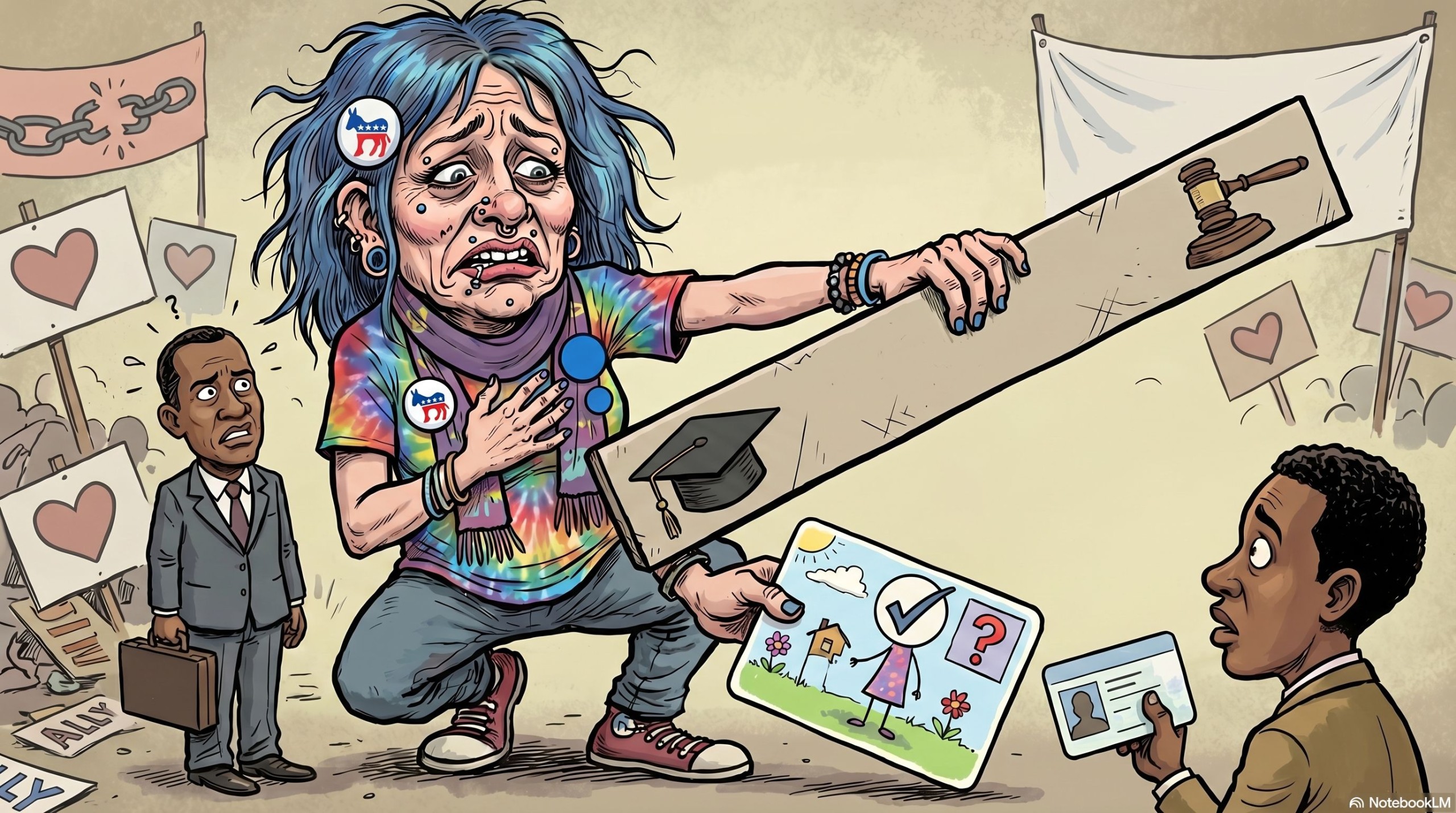
This pattern repeats everywhere. She opposes standardized testing because she believes minorities can’t compete on merit. She supports lowering professional standards because she assumes minorities can’t meet them. She advocates for separate grading criteria, separate admission standards, separate expectations, all while calling it equity. What she’s actually saying, beneath all the compassionate vocabulary, is: “These people aren’t as smart as I am, so the rules need to be different for them.” That’s not allyship. That’s bigotry with a gift bow on it.
The false identity: the Ally. The Big-Hearted Bigot genuinely believes she is fighting for the marginalized. She wears the label with pride. She will list her credentials (protests attended, petitions signed, hashtags deployed). What she will never do is treat the people she claims to be helping as equals. Equals don’t need you to lower the bar for them. Equals don’t need you to assume they can’t navigate a DMV. Equals don’t need a white savior explaining to other white people what Black people supposedly can’t handle.
The real damage isn’t just the insult (though it is insulting). It’s the policy. When the Big-Hearted Bigot’s assumptions get codified into law and institutional practice, real people get hurt. Lowered standards communicate to minorities that less is expected of them, which over time produces exactly the outcome the Bigot predicted. It’s a self-fulfilling prophecy dressed up as social justice. You tell a group of people they can’t succeed without special help, build systems that assume they can’t succeed without special help, and then point to the results as proof that they can’t succeed without special help.
If this sounds like you, here’s the test. Take any policy position you hold about a minority group and reverse the races. If it sounds patronizing (or outright racist) when applied to white people, it was patronizing when you applied it to everyone else. You just couldn’t hear it over the sound of your own compassion.
The Evangelical Atheist

He doesn’t believe in God. That’s fine. Lots of people don’t believe in God, and most of them manage to go about their lives without making it their entire personality. The Evangelical Atheist is not most people.
The Evangelical Atheist has made unbelief into a mission. He doesn’t just lack faith; he has a burning, evangelical need to make sure everyone around him also lacks faith. He will bring up religion in conversations that have nothing to do with religion. He will find the Christian in any comment section the way a heat-seeking missile finds an engine. He will tell you, unprompted, that God is a fairy tale for weak minds, that religion has caused more wars than anything in history (it hasn’t), and that he follows Science and Reason while you follow superstition.
Notice that he doesn’t just not believe in God. He hates God. This is the contradiction he can never resolve, and it’s the one that makes the Evangelical Atheist such a fascinating species. You cannot hate something you believe doesn’t exist. You can be indifferent to it. You can find the concept silly. But hatred requires an object, and the Evangelical Atheist’s hatred is far too personal, far too visceral, to be aimed at a concept he genuinely considers fictional. He argues with God the way you’d argue with an ex, not the way you’d argue with the Tooth Fairy.
The false identity: the Rationalist. The Evangelical Atheist has convinced himself that he arrived at his position through pure logic, untainted by emotion or cultural influence. He is the freethinker in a world of sheep. He follows evidence wherever it leads.
Except he doesn’t. Ask him about Evolution and he’ll present it as settled, proven fact. It isn’t. It’s a theory (in the scientific sense, yes, but also in the ordinary sense: a framework built on interpretation of evidence, containing significant gaps, hotly debated at its margins, and unfalsifiable at its core). The Evangelical Atheist doesn’t know this because he hasn’t actually read the primary literature. He has absorbed the cultural consensus and mistaken it for independent analysis. He has done exactly what he accuses religious people of doing: accepted on faith what his authorities told him.
And that’s the real joke. The Evangelical Atheist has a belief system with all the features he claims to despise in religion. He has sacred texts (Dawkins, Hitchens, Harris). He has orthodoxy (materialism, naturalism, the sufficiency of empirical observation). He has heretics (anyone who questions the consensus). He has a missionary impulse that rivals any televangelist’s. He has a definition of “religion” that conveniently excludes his own belief system from scrutiny. He defines religion as “believing things without evidence” and then refuses to examine whether his own foundational commitments meet that same standard.
What he calls “rational” is actually “things my tribe believes.” What he calls “superstition” is “things the other tribe believes.” He’s not a freethinker. He’s a conformist who picked the tribe that calls itself freethinking.
The damage he does isn’t to religion (religion has survived far more formidable opponents). It’s to actual rational discourse. Every time the Evangelical Atheist shuts down a conversation with “sky daddy” or “invisible friend,” he makes it a little harder for honest skeptics (the real kind, the kind who ask questions they actually want answered) to be taken seriously. He’s the atheist equivalent of the street-corner preacher with a bullhorn: technically on the same team, but an embarrassment to everyone else wearing the jersey.
If this is you, try something uncomfortable: apply the same scrutiny to your own beliefs that you demand of religious people. Define your foundational assumptions. Identify what evidence would change your mind. If the answer is “nothing would change my mind,” congratulations. You’ve just described religious faith. You’re just practicing it without the hymns.