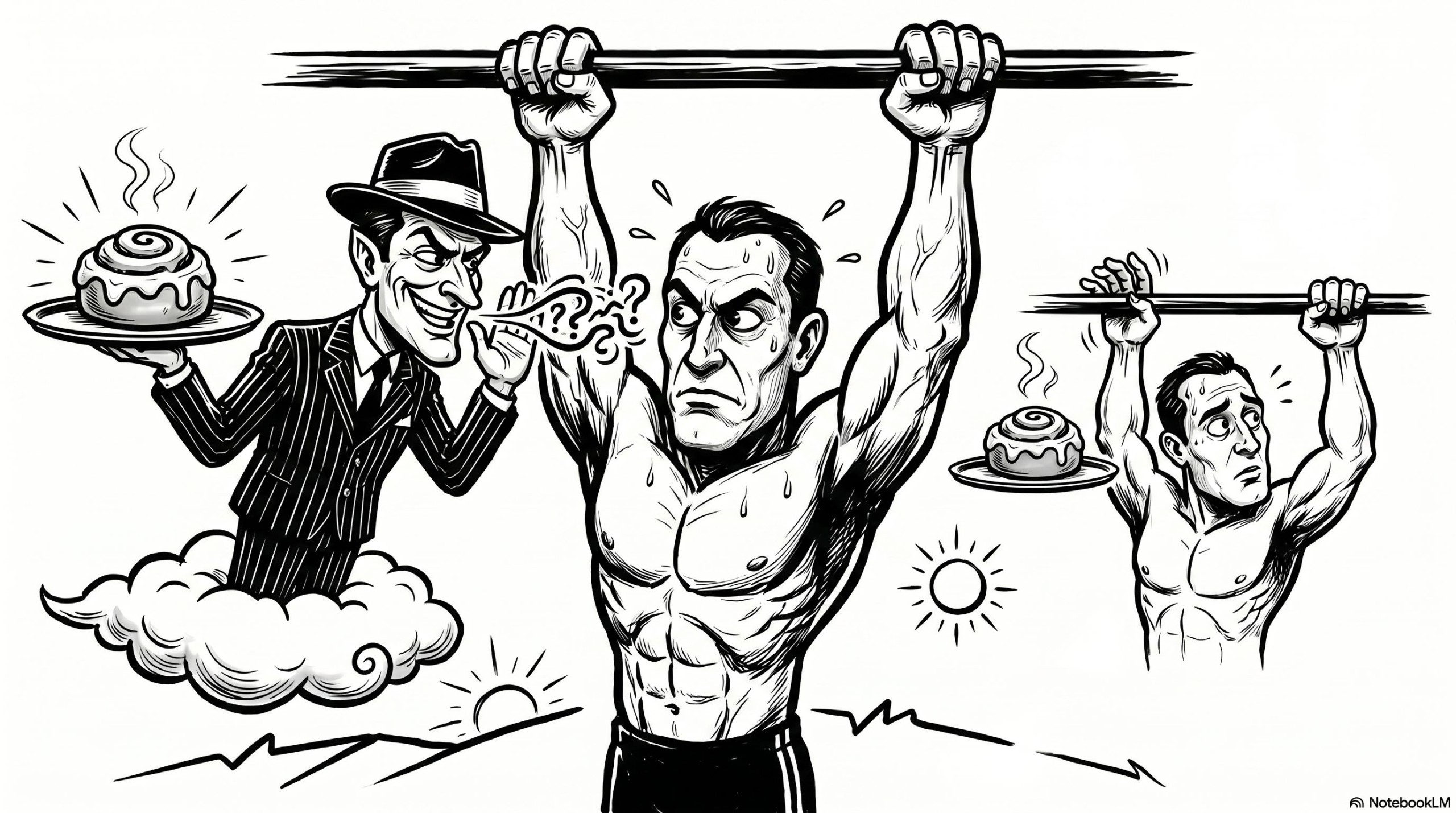
Do you ever do a Dead Hang? It’s not a pull-up or a chin-up, it’s just grabbing the bar and hanging for as long as you can.
I had to work up to my full weight, but then I’ve been increasing the time I hang. I’m up to 30 seconds on most days. I take three deep breaths, then begin. The first ten seconds are fairly easy. My grip is solid and it’s not that difficult, yet. Somewhere around fifteen seconds a voice shows up, and it’s not the kind that announces itself. It’s calm, almost reasonable. It says: “You could let go now, you’ve made your point. This is getting uncomfortable and there’s no particular reason to keep doing it.”
That voice is not my friend. It’s more like a lobbying firm that works for the part of me that wants things to stay easy. It doesn’t scream; it negotiates. And if I’m not paying attention, it can wins before I realize what’s happening.
The reply to that voice is No. Not a grand declaration or some teeth-gritting act of determination, just a quiet internal refusal that barely registers as a thought. I’m not letting go yet. One more second.
In the last piece I introduced YES as the small internal act that initiates each rep, each task, each discrete beginning throughout your day. YES starts things. But some things don’t need starting, they need surviving.
Hanging from the bar isn’t a rep. There’s no beginning-middle-end cycle, there’s just duration, and the question of how long you’ll stay in contact with something that wants you to stop. The quit-voice fires and NO answers it, and the whole exchange happens so fast that most people don’t catch it happening. They just notice they let go.
That’s the distinction worth naming. YES is what starts a thing, and NO is what keeps you inside the thing after the part of you that wants comfort starts lobbying for the exit. Different muscle, different moment, different training.
Here’s the observation that changed how I think about this: the quit-voice doesn’t win when it’s loudest or when the pain is worst. It wins when I drift.
When your mind wanders away from the bar and toward the next thing, the comfortable thing, the thing after this, the quit-voice doesn’t need to overpower you. It just needs you to stop noticing it’s talking.
Go back to the bar. At twenty seconds my hands start getting weaker and the voice is active, and if I’m paying attention, I can hold on. The moment I stop focusing, the moment my attention slides to what I’ll do after you let go, my fingers open. Not because the pain won, but because I left the conversation.
NO is not a one-time decision. It’s a sustained reply, and it only works when you’re present for the exchange.
But NO doesn’t just live on pullup bars. It lives in your refrigerator.
One of my sons bought a large cinnamon roll, the kind dripping with sugary glaze, the kind that looks like it was engineered in a lab to defeat every good intention you’ve ever had about eating. In passing he said, “There’s a cinnamon roll in the fridge if you want it.” Well-intentioned, completely innocent, and now I had a problem.
The first NO was easy enough. I’m not eating that, I know what it’ll cost me, and the conversation was over before it started. The second NO came an hour later when I opened the fridge for something else and there it sat. The third came that evening, and the next morning, and the next afternoon. Every single time I opened that refrigerator there was the cinnamon roll and there was the pitch: it’s right there, you’ve been good, one won’t kill you, you deserve something nice.
Until this morning when it finally vanished from the fridge (I didn’t ask questions), I was saying NO to that cinnamon roll on a recurring basis. Not once, not as a policy decision I made and filed away, but as a fresh negotiation every time I reached for the milk. That’s how temptation actually works. It doesn’t ask once and accept your answer. It asks again, and again, and every time it asks, you need to be present for the conversation or the cinnamon roll wins.
This extends to everything that looks pleasing, feels relaxing, or promises pleasure while quietly costing you something you care about.
The phone in your pocket is a cinnamon roll. So is the couch when you said you’d go for a walk, and so is the second drink, the third hour of television, the impulse purchase, the argument you know you should walk away from but walking away feels like losing. None of these are monsters. Most of them are fine in moderation. But moderation requires NO, and NO requires presence, and presence is exactly the thing these particular temptations are designed to dissolve.
The quit-voice and the temptation-voice are the same voice running two different pitches. One says stop doing the hard thing. The other says start doing the easy thing. Same lobbying firm, same strategy, same method of victory: catching you when you’re not paying attention.
There’s a third version of NO that doesn’t get enough credit, and it uses the same muscle: saying NO to other people.
Someone asks you for a favor you don’t have time for. A committee wants you to volunteer. A friend suggests plans you can’t afford. A coworker dumps a task on your desk with the assumption you’ll handle it. A family member pushes a boundary you’ve set three times already.
The internal experience is identical to the bar. There’s a voice (this time it sounds like guilt, or obligation, or the fear of being disliked) that says: just say yes, it’s easier, you’ll figure it out later. And the same quiet No that kept your fingers on the bar and your hands off the cinnamon roll is the only thing standing between you and a schedule full of other people’s priorities.
People who can’t say NO to themselves can’t say NO to anyone else either, because the muscle is the same. If you can’t hold the bar for another ten seconds against your own quit-voice, you’re not going to hold a boundary against someone else’s expectations. The internal discipline and the external discipline are connected at the root.
A practical note, since this series is about tools you can actually use.
You can’t train NO by thinking about NO. You train it by catching the quit-voice in real time. Next time you’re exercising, or doing anything where the question is how long you’ll stay rather than how many you’ll do, watch for the voice. Don’t fight it or argue with it. Just see it. There it is. I hear you.
The more you catch it, the more you’ll start catching it everywhere. In the fridge. On the couch. In conversations where someone is pressuring you and your fingers are starting to open.
No is not a wall you build once. It’s a conversation you keep having with the part of you that wants to let go, and you can only win that conversation if you show up for it.