Part 1 of 2
George Orwell was a Socialist.
Not secretly or reluctantly or in a “well, technically” kind of way. He was a committed, vocal, lifelong democratic socialist who wrote that every serious line he’d produced since 1936 was “against totalitarianism and for democratic socialism.” He joined a Marxist militia in the Spanish Civil War and fought on the front lines for the “Republican”* cause.
And then he spent the rest of his life writing the two most devastating indictments of Collectivism in the English language.
That’s not a contradiction; Orwell understood something that today’s Moderate Democrats desperately need to grasp: the most dangerous threat to moderate Collectivism isn’t Individualism. It’s extreme Collectivism. The thing that will destroy your policy goals, consume your political institutions, and leave your principles unrecognizable isn’t the people across the aisle. It’s the people three seats down on your own bench.
Orwell didn’t just theorize about this; he lived it. In Spain, he went to fight fascists and ended up being hunted by Soviet-backed Communists — people on his own side who decided that anyone insufficiently radical was the enemy. The Stalinists didn’t target conservatives. They targeted socialists like Orwell who wouldn’t fall in line. His own tribe tried to kill him.
Animal Farm and 1984 weren’t written by a man who feared the Right. They were written by a man who watched the Left eat itself and understood the mechanism.
The House on the Coast
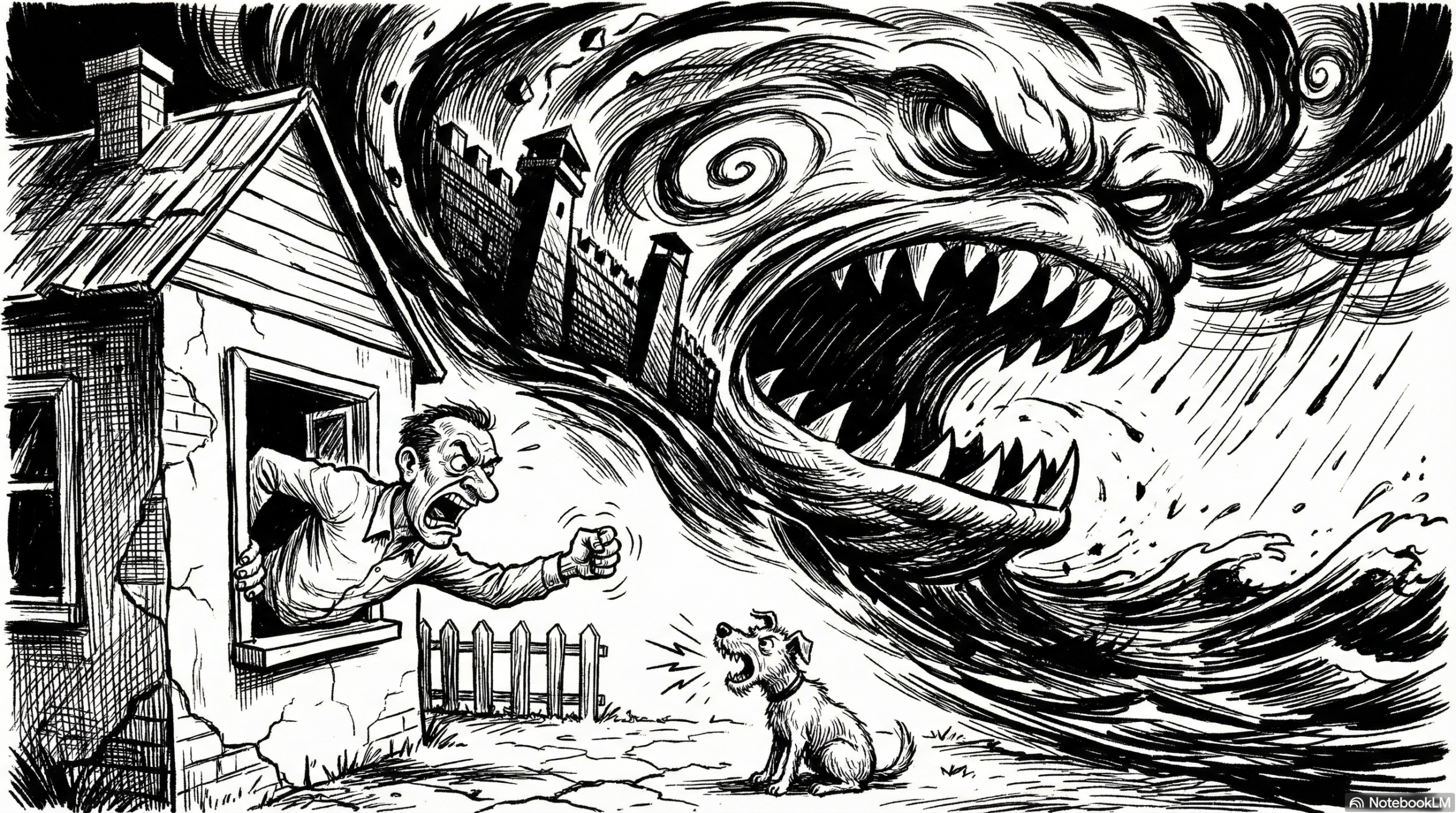
Imagine you buy a house on the coast with a beautiful view. You can see the ocean from every window. The sunsets are spectacular and the sound of the waves helps you sleep.
But you’re worried about the neighbors inland. They play their music too loud. Their dog barks. They park their truck where it blocks your view of the road. You spend your weekends writing letters to the HOA, attending community board meetings, arguing about property lines and fence heights.
Meanwhile, the hurricane season has started. Not a just a simple storm, a persistent pattern of increasingly severe weather that everyone in your area can see forming on the radar. The seawall is cracking. The insurance company just dropped your coverage. Your foundation is showing stress fractures from the last storm surge.
But you’re still focused on the neighbors’ dog.
This is the Moderate Democrat’s political situation in 2026. The threat you’re organized against, the Individualist Right, the populist movement, the MAGA coalition, is the neighbor’s dog. Annoying? Maybe. Loud? Certainly. An existential threat to your home? Not even close.
The hurricanes are already here. They’re coming from your Left. And they are not going away.
What the Wedge Predicts
If you’ve been following this series, you know the Political Wedge, a two-dimensional spectrum where Collectivism sits on the left, Individualism on the right, and the Leader/Follower gap creates a wedge shape that’s wide on the Collectivist end and narrow on the Individualist end.
One of the structural features of this model is gravitational pull. Collectivism naturally concentrates power over time. Every bureaucracy expands. Every regulation creates administrators who benefit from more regulation. Every program builds a constituency that resists its reduction. This isn’t conspiracy, it’s mechanics. You don’t need bad actors (although they are inevitable). You just need the slope.
Moderate Democrats live on that slope. They believe, sincerely, and sometimes correctly, that certain collective solutions serve certain people better than pure Individualism. Public education, infrastructure, safety nets for people in genuine need. These aren’t insane positions. They’re the kind of moderate Collectivism that can work when it’s carefully bounded and democratically accountable.
But “carefully bounded” is exactly what the slope erodes.
The mechanisms Moderate Democrats built for modest collective goals don’t stay modest. They get captured. The regulatory agency designed to keep markets fair becomes the tool for picking winners. The education system built to serve students becomes the vehicle for ideological conformity. The social safety net designed to catch people who fall becomes the system that discourages them from standing up.
None of this requires a villain. It just requires time, gravity and inattention.
The Threat You Won’t Name
Here’s what makes this worse: the people accelerating the slide aren’t just random extremists. They’re your party leadership.
When the DNC embraces positions that treat dissent as bigotry rather than disagreement, on gender ideology, on immigration enforcement, on speech restrictions, that’s not moderation. That’s the Leader/Follower gap widening. When governors assumed extraordinary powers during COVID and were visibly reluctant to surrender them, that wasn’t public health. That was the taste of centralized control, and it tasted good to people who already leaned that direction.
When a self-described Democratic Socialist takes the mayor’s office in New York and immediately begins consolidating institutional power, revoking accepted definitions, installing ideological allies, actively obstructing federal law, that’s not progressive governance. That’s the leftward slide picking up speed.
And Moderate Democrats watch this happening and say… nothing. Or worse, they defend it, because the alternative feels like siding with the other team.
This is the Handle working exactly as designed. The Democratic Party is a Handle. Loyalty to it prevents Moderate Democrats from honestly assessing the Principles being practiced under that label. You’re so worried about what the label on the other side might do that you can’t see what the label on your side is already doing.
Orwell could see it. It cost him friends, reputation, and nearly his life. But he could see it because he cared more about the Principle than the Handle.
The question for Moderate Democrats is whether they can do the same — before the hurricanes make the choice for them.
Tomorrow: what extreme Collectivism actually does to moderate Collectivist goals, and why the slope is steeper than you think.
*During the Spanish Civil War the “Republicans” were loyal to the left-leaning Popular Front government of the Second Spanish Republic and included socialists, anarchists, communists, and separatists, supported by the Soviet Union. The opposing Nationalists were an alliance of fascist Falangists, monarchists, conservatives, and traditionalists, supported by Nazi Germany and Fascist Italy.