Part 2 of 2 (Read Part 1 here.)
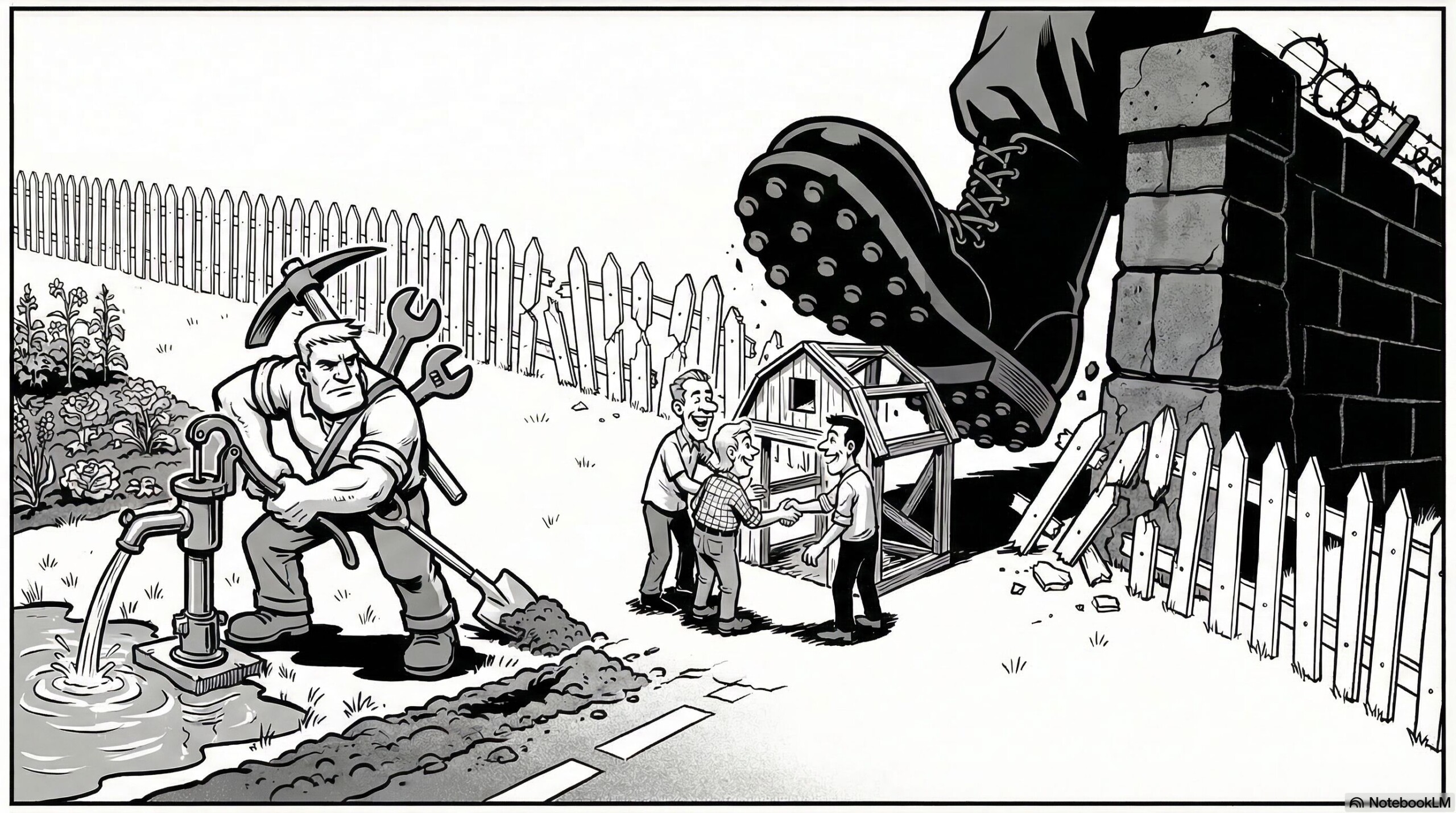
Across America there are all kinds of fences. Tough sturdy fences designed to limit the movement of massive, beasts who could trample a lesser fence without even thinking Then there are those smaller, decorative fences, designed to look ice, but also to mark territory. The white picket fence has been a symbol of the American dream for a long time. It’s not a very sturdy fence, and most people could knock it over by just leaning on it, but it served as a suggested barrier, to be respected by those who chose to be civilized and respectful.
The image of the white picket fence has stayed with me because it captures something most political philosophies get wrong about the relationship between freedom and structure. The Collectivist looks at the field and sees animals that need to be penned and design their fences accordingly. The Anarchist looks at the fence and sees an offense against human nature. The Libertarian — the serious one, not the bumper-sticker variety — looks at both and understands that the private property only works because the fence is respected, and only holds because people mostly choose not to test it.
This is the article where I tell Libertarians what Individualism actually costs. Because “leave me alone” is not a political philosophy. It’s a mood. And moods don’t build civilizations.
The Price of Self-Reliance
Individualism means you are willing to do for yourself what others expect the government to do.
Read that again, because it’s the sentence that separates the serious Libertarian from the cosplay variety. It doesn’t say you’re willing to talk about doing it for yourself. It doesn’t say you think other people should do it for themselves. It says you are willing to do it.
That means when your neighbor’s house floods, you don’t wait for FEMA. You show up with a truck and a pump. When the road to your community is deteriorating, you don’t file a complaint with the county. You organize a work crew. When someone in your church or neighborhood falls on hard times, you don’t point them toward a government program. You open your wallet and your calendar.
This is where most Libertarian rhetoric collapses under its own weight. The philosophical case for smaller government is only coherent if the people making it are willing to fill the gap with their own effort, time and money. If your version of Individualism is “the government shouldn’t do it and neither should I,” you’re not an Individualist. You’re a freeloader with a philosophy degree.
And you need to accept the consequences. Self-reliance means outcomes are unequal, and some of those outcomes are yours. It means nobody is coming to bail you out when your business fails or your investment tanks or your health deteriorates. It means the safety net you’re arguing against dismantling is one you personally won’t have. That’s the deal. If that price is too high, say so honestly. Don’t hide behind abstract principles you wouldn’t accept when applied to your own life.
Community Is Not Collectivism
This is the distinction that lazy Libertarians almost universally miss, and it’s the one that matters most.
Collectivism is compulsory. It operates through the mechanism of state power — taxation, regulation, mandate, enforcement. You participate because the alternative is penalty. Your “consent” is irrelevant. The system doesn’t require your agreement. It requires your compliance.
Community is voluntary. It operates through the mechanism of shared purpose — neighbors deciding together to maintain a park, fund a food bank, build a playground, support a family in crisis. You participate because you choose to. You can walk away. The system doesn’t compel your involvement. It earns it.
These are not the same thing, and the failure to distinguish them has crippled the Libertarian movement for decades. When a Libertarian reflexively opposes any collective action — including voluntary, local, organic community effort — he isn’t defending Individualism. He’s defending isolation. And isolation isn’t a philosophy. It’s a failure mode.
The serious Individualist understands that humans are social creatures who accomplish more through cooperation than alone. The question was never whether people should work together. The question is whether that cooperation is voluntary or coerced. The PTA is not the Politburo. The neighborhood watch is not the secret police. The church potluck is not a breadline. Treating them as equivalent is not principled. It’s lazy.
Voluntary community is, in fact, the mechanism by which Individualism proves its case. Every time a neighborhood solves a problem without government intervention, every time a charity serves people better than a bureaucracy would, every time a voluntary association accomplishes what a mandate could not — that’s evidence. That’s the argument made flesh. The Libertarian who won’t participate in voluntary community isn’t just missing the point. He’s destroying the evidence for his own case.
Election Box Roulette
There’s another cost to Individualism that most Libertarians refuse to pay: the time and effort required to be an informed voter.
Voting is not a tribal ritual. It’s not a matter of checking the box next to the name with the right letter after it, or the name your preferred media personality endorsed, or the name you vaguely recognize from a yard sign. That’s Election Box Roulette — spinning the cylinder and pulling the trigger, hoping the chamber you landed on isn’t loaded.
An Individualist votes the way an Individualist does everything else: by doing the work first. That means studying the candidates — not their slogans, their records. Not their promises, their votes. It means understanding the ballot measures well enough to explain them to someone else. It means accepting that sometimes the best available candidate is deeply flawed and voting for them anyway, because the alternative is worse, and sometimes it means accepting that none of the candidates meet your standards and writing in someone who does — knowing that your vote is a statement of principle, not a prediction of outcome.
This is tedious. It requires hours of reading, comparison and thought. Most people won’t do it. Most people will vote the Handle and feel righteous about it.
But the Libertarian who votes the Handle is the most absurd creature in politics — someone who claims to think for himself and then demonstrates, at the one moment his thinking is actually tested, that he doesn’t.
The Fence
Individualism can only exist within a framework that secures individual liberties. That framework — however minimal — is the fence. And the fence is what separates the Libertarian from the Anarchist.
The Anarchist says: tear down the fence. All fences. The individual is sovereign, and any structure that constrains sovereignty is illegitimate.
The Libertarian says: the fence is necessary, but it should be as low and as light as possible. Just enough to mark the boundary. Just enough to show the boundaries. Not a prison wall. A property line.
This is a defensible position. It’s also a fragile one, because a light fence only works under one condition: the people inside it must voluntarily respect the boundary. They must treat the fence as a guideline for their own behavior, not a barrier to be tested. The moment enough people start leaning on it — gaming the system, exploiting the gaps, pushing every boundary to see what they can get away with — the fence fails. And when the fence fails, the Collectivists show up with concrete and rebar, because the public will demand a stronger structure, and the only people offering one are the people who wanted walls all along.
This means the Libertarian has a responsibility that the Collectivist does not. The Collectivist can afford people who misbehave — that’s what the enforcement apparatus is for. The Libertarian cannot, because the whole system depends on people choosing well. Every Libertarian who cheats, grifts, freeloads, or acts in bad faith is termite damage in the fence. Enough termites and the Collectivists don’t even have to push. The fence falls on its own.
The Sober Truth
I’m a registered Republican who respects the Libertarian position. I think the Individualist end of the spectrum is closer to the truth about human dignity than the Collectivist end. I also think the Libertarian movement is its own worst enemy — not because the philosophy is wrong, but because too many of its adherents are unwilling to pay the price the philosophy demands.
Individualism is not the default. It’s not what happens when you remove government. What happens when you remove government is chaos, predation and the rapid emergence of the strongest Collectivist in the room. Individualism is what happens when free people choose to govern themselves — their behavior, their communities, their responsibilities — with enough discipline and generosity that the fence holds.
That takes work. Physical work, intellectual work, moral work. It means showing up for your neighbor, studying your ballot, building your community, and defending your principles with something more substantial than a slogan.
The field is yours. But only if you’re willing to work it.