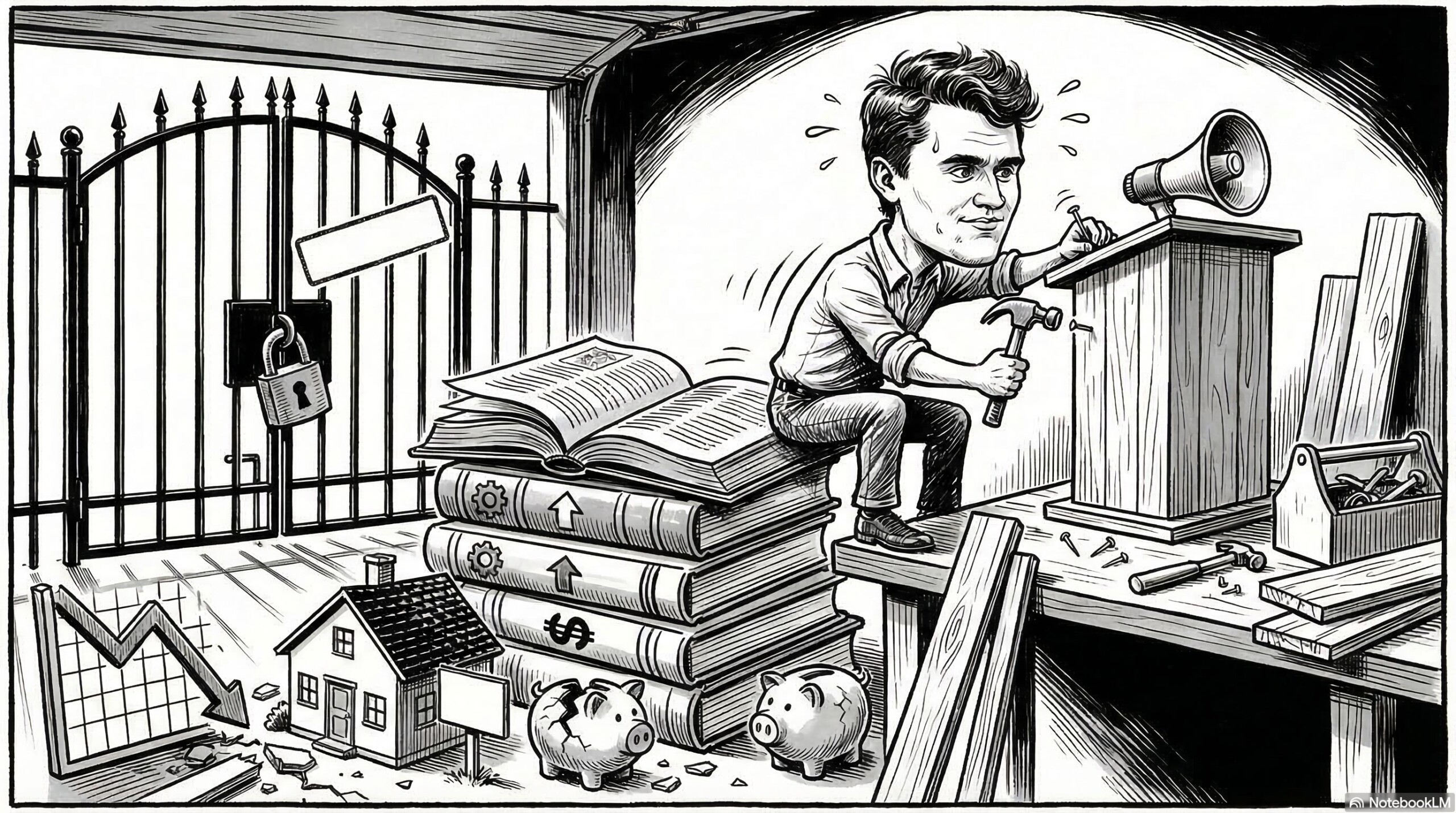
First in a five-part series on what it would actually take to mean it when you say “I am Charlie Kirk.”
There’s a scene in The Delta Force (1986) that captures something most people have forgotten. Terrorists hijack a plane and demand the Jewish passenger come forward. Father O’Malley, played by George Kennedy, stands up, walks forward. Abdul, the terrorist, says, “I did not call you.” The priest replies, “You called for all the Jews. I’m Jewish, just like Jesus Christ. You take one, you gotta take us all.” He was making a declaration: you meant to isolate them, but I’m stepping into their place.
That was the spirit of “I am Charlie Kirk” when people first said it after his assassination in September 2025. It meant: you thought you’d silence him, but I will carry on his work. I am the next Charlie Kirk.
But, it’s become a bumper sticker. People put it on their trucks, post it in their bios, say it at rallies, and most of them couldn’t tell you what Charlie Kirk actually did that made him worth emulating. They’re holding a Handle without knowing what’s attached to it.
This five-part series is about what’s actually attached to it. Part 1 covers the formation, how a middle-class kid from the Chicago suburbs became the person people now claim they want to be, and what that demanded of him before anyone knew his name.
The Reader
Charlie Kirk was born October 14, 1993, in Arlington Heights, Illinois, and raised in nearby Prospect Heights. His father was an architect. His mother was a former trader at the Chicago Mercantile Exchange who later retrained as a mental health counselor. They were moderate Republicans, in a Presbyterian household, private people, not political activists. Nobody in the Kirk home was grooming a future conservative firebrand.
In middle school, Charlie started reading Milton Friedman. It wasn’t assigned or handed to him by a parent with an agenda. He went looking for a framework to understand the world and found one in free-market economics. The intellectual foundation came first, before the activism and before any of the things people now associate with his name. Most people who say “I am Charlie Kirk” have never read a single book that Charlie Kirk read. They adopted the brand. He built the foundation.
This matters because the popular narrative skips it. People remember the debater, the provocateur, the guy behind the table with the “Prove Me Wrong” sign. But that version of Charlie was built on a foundation of ideas he chose to pursue on his own, as a kid, because he wanted to understand how things worked.
Are You Charlie?: Charlie Kirk didn’t wait for someone to hand him a worldview. He built one from books he chose to read. What’s the last book you read that actually challenged how you think? Not one that confirmed what you already believed, but one that made you sit with an idea you hadn’t considered before. If you can’t name one, you’re not “Being Charlie”, you’re wearing the bumper sticker.
The Recession
The 2008 financial crisis hit the Kirk family directly. His father’s architecture business suffered. By 2012, the family couldn’t pay for college. It wasn’t actually poverty; it was the particular sting of watching an upper-middle-class life contract, because the economy punished everyone, including people who’d played by the rules.
For Charlie, Friedman stopped being theory. He’d read about free markets as an abstraction; now he watched free-market principles validated, or their violation punished hard-working people even in his own household. The bailouts, the government interventions, the cascading consequences, he could trace the line from policy to his family’s kitchen table. Abstract philosophy became personal conviction. He had stakes in the argument now.
The recession cemented Charlie Kirk ideology the way it cemented the ideology of an entire segment of the Republican Party, the segment that became the Tea Party. His wasn’t an inherited political identity. It was forged by watching what happens when the ideas in the books collide with the reality in your living room.
Are You Charlie?: Charlie’s political convictions got tested when the economy hit his family personally. Convictions that haven’t survived contact with reality are just opinions. What have you actually lived through that shaped what you believe? Can you trace the line from the experience to the principle? If your politics are inherited rather than tested, they’ll fold the first time they cost you something.
The Debater in Hostile Territory
Wheeling High School was diverse and Charlie was a white minority. He described himself as “naturally conservative” and spent his high school years trying to persuade classmates who had never heard a Republican argument in their lives. This wasn’t a debate club. There were no judges, no points, no trophies. He was learning to make the case cold, in unfriendly territory, to people who thought he was wrong before he opened his mouth.
That’s where the evangelist instinct formed, not in front of friendly audiences or on stages or behind a microphone, but in a high school hallway where the response to “I’m a conservative” was more likely to be a blank stare or a laugh than applause.
During his junior year, he volunteered for the senate campaign of Illinois Republican Mark Kirk (no relation). He said he did it on a whim. It was his first exposure to real political mechanics, how campaigns actually work, how votes get organized, how persuasion operates at scale.
Are You Charlie?: Charlie Kirk didn’t practice his arguments in front of people who already agreed with him. He learned to persuade by talking to people who thought he was wrong. When was the last time you made your case to someone who disagreed, not to win a fight online, but face-to-face, where you had to actually listen to the pushback? If your idea of political engagement is sharing memes with people who already think like you, you’re a cheerleader, not a Charlie Kirk.
The Pattern: Act, Don’t Talk
Here’s where the biography turns into a lesson. Watch the pattern:
Charlie organized students to boycott the school cafeteria over a cookie price hike. Some classmates called it a prank. But it worked. The school reduced the price. He was sixteen. He didn’t post about it. He organized.
Senior year, April 2012, he wrote an essay for Breitbart News criticizing liberal bias in his AP Economics textbook, Krugman’s Macroeconomics for AP. An unsolicited submission from a high school kid. Breitbart published it. It led to a Fox Business appearance. He was seventeen.
Neither of these required money, connections, status or permission. They required the willingness to actually do something about what bothered him instead of just talking about it. A petition about cookies. An unsolicited essay to a website. Small bets. No guarantee of success. The kind of thing most people think about doing and then don’t.
That’s the pattern. Not talent. Not privilege. The instinct to act.
Are You Charlie?: Every one of these was a small action with no guaranteed payoff. A kid organized a boycott and wrote an essay. That’s it. What’s the smallest concrete step you could take this week about something that actually bothers you? Not a post, not a comment, not a share. An actual move. If you can’t think of one, you don’t actually care as much as you think you do.
The Backbone Problem
In 2012, Charlie applied to the United States Military Academy at West Point. He was rejected.
What happened next is where the story gets complicated, and instructive.
Charlie claimed publicly that he’d had a congressional nomination and that his slot went to a less-qualified candidate of a different gender and background. He said he knew her test scores. It was a specific, verifiable claim, not a vague grievance. But he never produced documentation for it publicly. And his later explanations for why he said it kept shifting: it was sarcasm, then he was repeating something he’d been told, then he claimed he’d never said it at all. The original complaint may have been entirely valid. We don’t know. What we do know is that the shifting explanations became the problem.
Here’s the part most retrospectives miss, because they’re too busy either defending Charlie or burying him: the same emotional backbone that made him organize a boycott at sixteen, write to Breitbart at seventeen, and pitch his parents on skipping college at eighteen is the same backbone that, aimed poorly, produces statements you can’t back up or walk back cleanly.
This is not a flaw unique to Charlie Kirk. It is the standard equipment of people who actually do things in the world. Future leaders almost always come across as jerks at some point, because the trait that drives them to act is not the same trait that teaches them when to hold their tongue. The people with the emotional backbone to stand up are the same people capable of saying something reckless when they’re angry or hurt. That’s not an excuse, it’s a description of how the machinery works.
The growth question for any young leader is whether the reckoning that follows pushes them toward a deeper respect for truth, or toward image management and political calculation. Charlie’s shifting explanations suggest he learned the political lesson — how to manage a narrative — faster than the moral one — how to simply tell the truth, even when it’s inconvenient.
Are You Charlie?: The backbone that makes you act is the same backbone that makes you say things you’ll regret. That’s not a force to eliminate. It’s a force to discipline. When you’ve said something reckless, did you correct course toward honesty, or toward spin? Most people, if they’re being honest with themselves, know the answer. The goal isn’t to never be reckless. The goal is to clean it up with the truth when you are.
The Pivot
Charlie said he wallowed for a week or two after the rejection, then got sick of it. He’d been accepted to Baylor University but couldn’t afford it, the post-2008 financial reality hadn’t changed. So the traditional path was closed.
In May 2012, Charlie gave a speech at a Benedictine University event and met Bill Montgomery, a retired businessman and Tea Party activist who’d been impressed by Charlie’s Breitbart essay and Fox appearance. Montgomery saw something in him and encouraged him to skip college entirely and build a political movement. Charlie pitched his parents on a “gap year,” which he later admitted was really about ninety days before Montgomery offered to fund the vision.
He founded Turning Point USA right out of Wheeling High School. From a garage. With, by his own admission, “no money, no connections and no idea what I was doing.” He’d seen MoveOn.org active in his school and wanted to build the conservative mirror image. He’d gone to the Illinois GOP asking for help starting a youth conservative group. They told him it wasn’t a good idea. So, he built it outside the party structure entirely.
That response (rejection, pivot, build) is arguably more important than anything else in this stage. The path he wanted was closed. Instead of forcing a lesser version of it, or quitting, he built a completely different one. And when the established institution told him no, he didn’t argue. He went around them.
Have you noticed how many political organizations started precisely this way? Someone goes to the existing structure, the existing structure says no, and the someone builds a competitor that eventually eats the original’s lunch. The Moral Majority started that way. The Christian Coalition started that way. Now Turning Point USA. The Republican establishment has a long and impressive history of telling its most effective future allies to go away.
Are You Charlie?: Charlie got rejected from the path he wanted and built a different one. The Illinois GOP told him no; he didn’t argue, he went around them. What’s the thing you’ve been waiting for permission or approval to do — and what would it look like to just start?
The Test
Almost none of what you just read required special access or privilege. Middle-class kid. Public school. No political dynasty. No donor network. No connections worth mentioning.
What Charlie Kirk had was the instinct to act on what bothered him, and the resilience to channel rejection into construction rather than self-pity. That instinct came with a cost, the same fire that drove him to act also drove him to say things that were reckless or self-serving. That’s not a disqualifier. It’s the standard equipment of people who build things. The question is always what they do with it as they mature.
That’s the “Being Charlie” test — Part 1 edition. Not the bumper sticker. The pattern. If you claim to be carrying on his work, you need to be the person who does something when something bothers you, not the person who posts about it and moves on. And you need to be honest enough with yourself to know when your backbone is serving the truth and when it’s just serving your ego.
Being Charlie: The Reading List
Charlie published his own recommended reading list, the books he said every political mind should engage with. If you’re claiming to carry on his work, this is the homework.
- Gulag Archipelago — Aleksandr Solzhenitsyn
- The Book That Made Your World — Vishal Mangalwadi
- Liberal Fascism — Jonah Goldberg
- Discrimination and Disparities — Thomas Sowell
- Capitalism and Freedom — Milton Friedman
- Man’s Search for Meaning — Viktor Frankl
The first five are Charlie’s published top five. The sixth appeared repeatedly in his broader recommendations, and if you read only one book on this list, make it that one. Frankl survived Auschwitz and three other Nazi camps, then wrote about how the people who survived were the ones who found a reason to. It connects to everything in this article: the backbone, the pivot, the refusal to wallow. Purpose isn’t something you find. It’s something you build. The same way Charlie built Turning Point from a garage.
Tomorrow, Part 2: The Gear Shift (The early Turning Point years)
Wednesday, Part 3: Meat and Potatoes (Later TPUSA)
Thursday, Part 4: The Generator (The 2024 election)
Friday, Part 5: The Vacuum (The Victory Lap and The End)