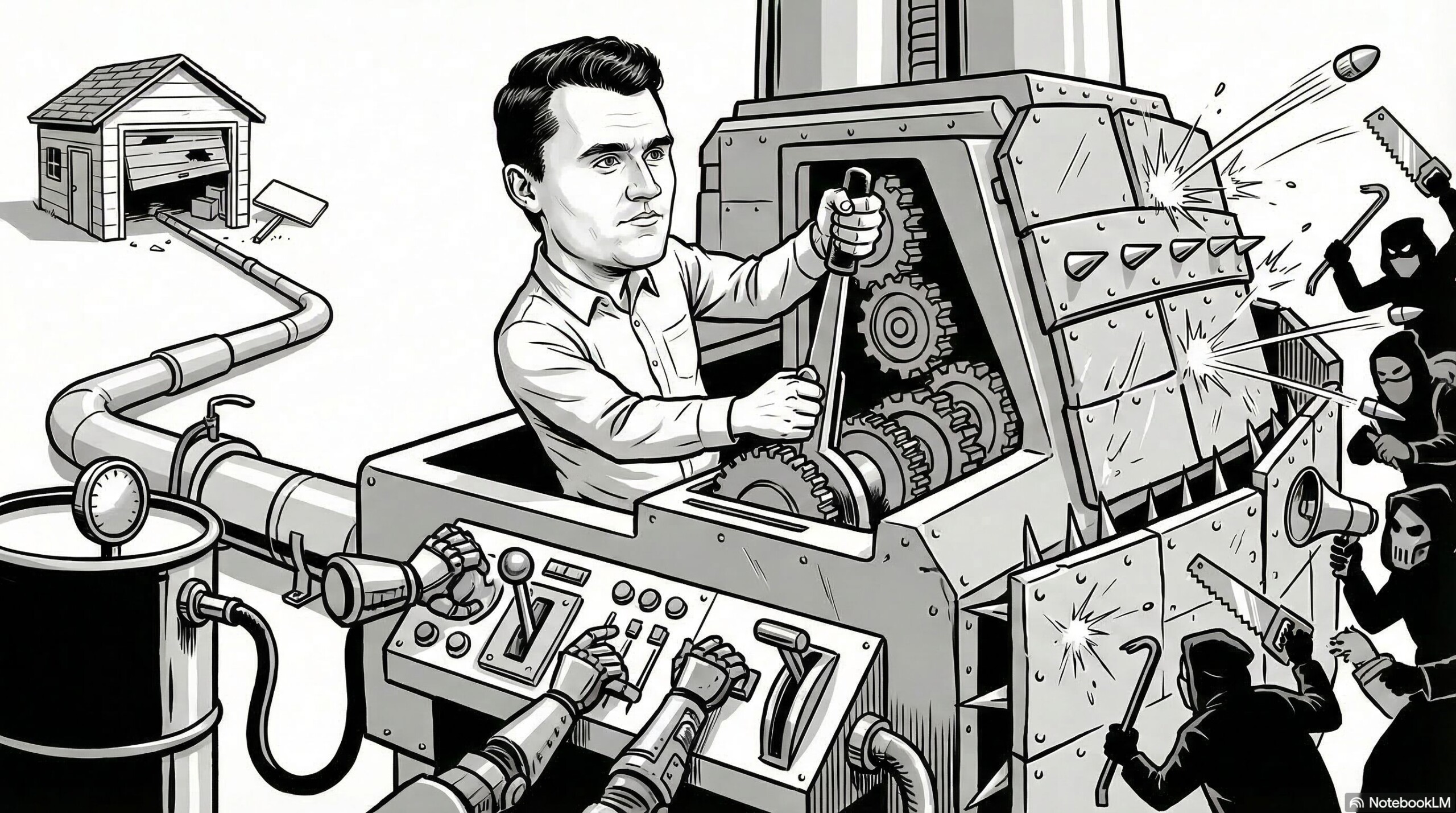
Second in a five-part series on what it would actually take to mean it when you say “I am Charlie Kirk.”
There’s a story about Alexander the Great — probably apocryphal, but useful. The version most people know is that he wept because there were no more worlds to conquer. The version closer to the ancient sources is darker: he wept because he couldn’t hold what he’d already taken. He was the greatest conqueror of the ancient world and a catastrophic administrator. His empire didn’t survive him by a single generation. It fractured into warring successor states before his body was cold.
This is the oldest problem in leadership: the skills that build a thing are not the skills that sustain it. Every founder hits this wall. The ones who conquer it learn to shift gears, from doing to delegating, from instinct to infrastructure, from moving fast to building things that hold. The ones who don’t end up like Alexander: brilliant, dead at thirty-two, and leaving behind a machine that nobody else knows how to operate.
Part 1 of this series covered the formation of Charlie Kirk’s leadership, the reader, the debater, the kid who acted instead of talked. This part covers the harder story: how the kid in the garage became the CEO of one of the most powerful conservative organizations in America, and what each transition demanded of him.
If you’re claiming to “be Charlie Kirk,” this is where the bumper sticker starts to cost something.
Crisis 1: The Empty Account (December 2012)
Six months after founding Turning Point USA, Charlie Kirk had less than a thousand dollars in the bank. He was ready to quit.
This isn’t a management crisis. It’s more fundamental than that; it’s the survival question that kills most ventures before they ever face a management question. The romantic version of entrepreneurship is the garage with the big idea, the scrappy underdog. The reality is that the garage phase is mostly just wondering if you should go get a real job.
Bill Montgomery, Charlie’s co-founder and mentor, talked him out of quitting. They went to New York, got Charlie back on Neil Cavuto’s Fox News show, and the exposure snowballed into new contacts and small donations. The organization survived.
The lesson here isn’t about Montgomery’s pep talk. It’s about what Charlie did after the pep talk. He didn’t go back to the garage and continue doing what had produced less than a thousand dollars. He got on a plane, went somewhere uncomfortable and put himself in front of people who could move the needle. The survival crisis didn’t demand a new strategy, it demanded the willingness to keep going when the current strategy hadn’t paid off yet.
Most people who start something, quit at this point. Not because the idea was bad, but because the gap between the vision and the bank balance is psychologically unbearable. Charlie endured it. And that’s the first gear-shift: from “I started something” to “I refuse to let it die.”
Are You Charlie?: Have you ever built something that hit the wall — financially, motivationally, logistically — and had to decide whether to keep going or walk away? What made you stay, or what made you quit? The answer tells you something about whether you’re built for what comes next.
Crisis 2: The Ask (2013–2014)
Turning Point’s revenue went from $78,000 in 2012 to $444,000 in 2013 to over $2 million in 2014. That didn’t happen because more students showed up. It happened because Charlie learned to fundraise.
The inflection point was a speaking event in Palm Beach in 2014. Charlie got in front of major Republican donors and convinced them to write six-figure checks. The Rauner Foundation gave $100,000. The Uihlein Foundation gave $275,000. Bernie Marcus’s foundation gave $72,000. Each donor opened the door to the next.
But this chain didn’t start in Palm Beach. It started in a stairwell at the 2012 Republican National Convention, where Charlie met Foster Friess and walked away with a five-figure commitment. It continued when Rebecca and Bill Dunn put in $50,000 of seed money, enough to hire first staff and open an office, which lent credibility that attracted the next round.
This is the second gear-shift, and it’s the one most activist-types can’t make. Charlie had to stop being the guy who drives to campuses and hands out flyers, and start being the guy who walks into a room of wealthy people and asks for money. Different posture. Different vocabulary. Different skill set entirely. The activist who says “the cause speaks for itself” is the activist whose cause dies broke. Charlie understood, probably instinctively, probably because he’d watched his father navigate professional relationships in architecture, that someone has to make the ask. Passion without funding is a hobby.
The people who say “I am Charlie Kirk” almost never mean this part. They mean the campus debates, the social media clips, the crowd energy. They don’t mean the part where you fly to Palm Beach, put on a suit, and convince a stranger to hand you a quarter of a million dollars for an organization that barely existed two years ago.
Are You Charlie?: Whatever you’re trying to build — a movement, a business, a community organization — who are you asking for help? Not rhetorical support. Not likes and shares. Actual resources. If the answer is “nobody,” you’re running a hobby, not a movement. What’s the ask you’ve been avoiding?
Crisis 3: The Handoff (2015–2016)
By 2015, Turning Point claimed a presence on 1,000 campuses with more than forty full-time field staff. Charlie couldn’t personally manage it anymore. He had to delegate and remember, delegation is where Alexander wept.
Charlie’s solution was Crystal Clanton. He hired her as national field director, and she effectively became the organization’s chief operating officer. She managed the field program, hired and trained staff, wrote the organizational playbooks. Charlie publicly called her “the best hire we ever could have made.” The handoff freed Charlie to do what only he could do: be the public face, the fundraiser, the media personality, the campus debater.
This is the third gear-shift, and it’s the one that separates founders who scale from founders who burn out. You cannot build a national organization and also personally run its daily operations. At some point, you have to trust someone else to execute your vision while you go raise the next round, do the next interview, give the next speech. Charlie made that shift. And for a while, it worked. Revenue kept climbing. Chapters kept multiplying. Fox News kept calling.
But the handoff also exposed a weakness in how Charlie built. His student government strategy, funding conservative candidates in campus elections, treating it like a real political operation, was ambitious and innovative. Charlie himself called it a “rather undercover, underground operation.” The problem was execution: candidates at Ohio State and the University of Maryland got caught violating spending rules and had to withdraw from their races. The strategy was designed for stealth, but the people executing it on the ground didn’t have the discipline or compliance infrastructure to pull it off cleanly.
That’s the cost of moving fast. Charlie built the playbook but didn’t build the guardrails. He delegated the work but not the standards. When you’re growing from a garage to a thousand campuses in three years, something is going to crack. What cracked was the gap between the sophistication of the strategy and the maturity of the organization executing it.
Are You Charlie?: When you hand something off — a project, a team, a responsibility — do you also hand off the standards? Or do you just hand off the tasks and assume the person will figure out the quality control? Charlie learned that delegation without infrastructure is just hoping. What have you delegated without building the systems to make sure it’s done right?
Crisis 4: The Culture You Didn’t Build (2015–2017)
This is the hardest one.
Crystal Clanton, the person Charlie trusted to run his organization’s field operation, sent a private text message to a colleague that included a racially charged statement. The messages dated to 2015–2016. Clanton resigned in August 2017 after Charlie confronted her about them. The story went national in December 2017 when Jane Mayer reported it in The New Yorker.
What gets left out of that narrative — always — is context. It was a private message, not a public statement. Anyone who’s ever vented in a text knows the difference between what you say in frustration to a friend and what you actually believe. The number of times Black politicians and commentators have said comparable or worse things about white people — publicly, on camera, on social media — without consequence is not small. It’s enormous. The media noticed zero of those. But a stolen private text from a Republican operative? That’s a hanging offense. The double standard isn’t incidental. It’s the mechanism. You selectively enforce norms against your opponents while exempting your allies, and then point to the enforcement as proof that only your opponents have the problem.
None of that excuses what Clanton wrote. But it reframes the question. The media’s version is: “Clanton was a racist, and Kirk either knew or should have known.” The more honest version is: someone on Kirk’s team said something ugly in a private moment, it was weaponized by people who wanted to damage the organization, and Kirk dealt with it within 72 hours of learning about it. That’s not culture failure, that’s an organization that handled a personnel problem when it surfaced, in a political environment where the rules of engagement are applied to one side and not the other.
The answer is the fourth crisis, and it’s one most people building something on the right still haven’t learned. Charlie and the people who worked under him underestimated how far their enemies would go. A private text — the kind of frustrated hyperbole that wouldn’t raise an eyebrow if it came from the other side — was stolen, leaked, and detonated in The New Yorker as proof that Turning Point was a racist organization. The text was ugly. But the operation that turned it into a national story wasn’t journalism — it was political demolition, and Charlie didn’t see it coming.
The fourth gear-shift wasn’t about building a better culture. It was about building for war. When you’re effective enough to threaten the people in power, they don’t argue with you — they go through your trash. They pull private messages, find the worst sentence anyone on your team ever typed, strip the context, and hand it to a sympathetic reporter. Charlie’s crisis was that he built an organization prepared for political combat but not for political espionage. He assumed a level of fair play that his enemies had abandoned years earlier.
Are You Charlie?: If you’re building something — anything with other people in it — what does the culture look like when you’re not in the room? Not what you hope it looks like. Not what you’ve written in a mission statement. What actually happens when you walk out? If you don’t know, that’s the problem. Charlie learned that the culture you don’t build is the culture someone else builds for you — and you might not like what they choose. Do you know what your enemies are willing to do? Not what you think is reasonable. What they’ve actually demonstrated they’ll do. Are you building accordingly?
The Gear-Shift Test
By the end of this period, Charlie Kirk had transformed from an eighteen-year-old in a garage into the youngest speaker at the 2016 Republican National Convention, a personal aide to Donald Trump Jr. on the campaign trail, and the CEO of an organization pulling in over eight million dollars a year with staff, infrastructure, and national reach.
He made three of the four gear-shifts. He learned to endure. He learned to fundraise. He learned to delegate. The fourth — recognizing that his enemies would go far beyond political opposition and into outright espionage against his own people — is the one that caught him off guard. Not fatally. The organization survived the Clanton scandal and kept growing. But it left a mark, and it left a lesson: when you’re winning, the other side doesn’t fight harder. They fight dirtier. And if you’re not building with that assumption baked in, you’re building on ground they’ve already mined.
Alexander the Great never made even the first shift. He conquered and conquered and conquered, and when he died, there was no machine behind him, just a collection of generals who immediately turned on each other. Charlie did better than Alexander. Whether the people who claim to “be Charlie Kirk” can do as well, or better, depends on whether they understand that building something is only half the battle. The other half is knowing that the people who want to destroy it won’t fight fair, and building accordingly.
Being Charlie: The Organizational Audit
Charlie Kirk’s reading list gave you the intellectual foundation. This part’s homework is operational.
If you’re building anything, a campus chapter, a local group, a church ministry, a business, answer these five questions honestly. Write the answers down. If you can’t answer one of them, that’s the assignment.
- What happens to your project if you disappear for two weeks? Does it run, stall, or collapse?
- Who is your Crystal Clanton, the person actually running things when you’re not in the room? Do you know what culture they’re building?
- Where is the money coming from next year? Not this month. Next year. If you don’t know, you don’t have a plan — you have a hope.
- What’s the one thing only you can do? Everything else should be in someone else’s hands. Is it?
- Who are your enemies, and what are they willing to do? Not what’s reasonable, what they’ve actually demonstrated. Are you building with that assumption baked in?
Charlie built from a garage to a thousand campuses in three years. He made the first three gear-shifts. The fourth, building for the reality that his enemies would fight dirty, caught him off guard. Don’t let it catch you.
Tomorrow, Part 3: from campus movement to political machine — how Turning Point became a force in national Republican politics.
The Full Series…
Monday, Part 1: Just a Kid.
Today, Part 2: The Gear Shift (The early Turning Point years)
Wednesday, Part 3: Meat and Potatoes (Later TPUSA)
Thursday, Part 4: The Generator (The 2024 election)
Friday, Part 5: The Vacuum (The Victory Lap and The End)