Third in a five-part series on what it would actually take to mean it when you say “I am Charlie Kirk.”
There’s a word people use without thinking about what it actually means: politics.
Strip away the civics-class veneer and substitute what the word actually describes in practice: manipulation. Every campaign ad, every rally speech, every carefully timed endorsement, every leaked memo, every strategic silence — it’s all manipulation. The nice version is “persuasion.” The honest version is that you’re trying to get people to do what you want them to do, and the ones who are best at it are the ones who make people feel like it was their own idea.
This isn’t a cynical observation. It’s the operating reality that anyone who enters politics eventually confronts. And here’s the paradox that sat waiting for Charlie Kirk when he stepped from campus organizing into the national political machine: if your cause is liberty — if your entire argument is that people should think for themselves, govern themselves, take responsibility for themselves — then the tool you’re forced to use to advance that cause is the opposite of the cause itself. You’re manipulating people toward freedom. Coercing them toward self-governance. Selling independence to a populace that, if we’re being honest, mostly wants to be told what to do.
Parts 1 and 2 of this series covered the formation of Charlie’s talents and organization and the gear-shifts he made to build Turning Point USA from a garage into a national organization. By 2016, at age twenty-two, he was the youngest speaker at the Republican National Convention. He’d learned to survive, to fundraise, to delegate. What he hadn’t yet learned was how to operate inside the machine that actually decides elections — and what that machine demands you trade.
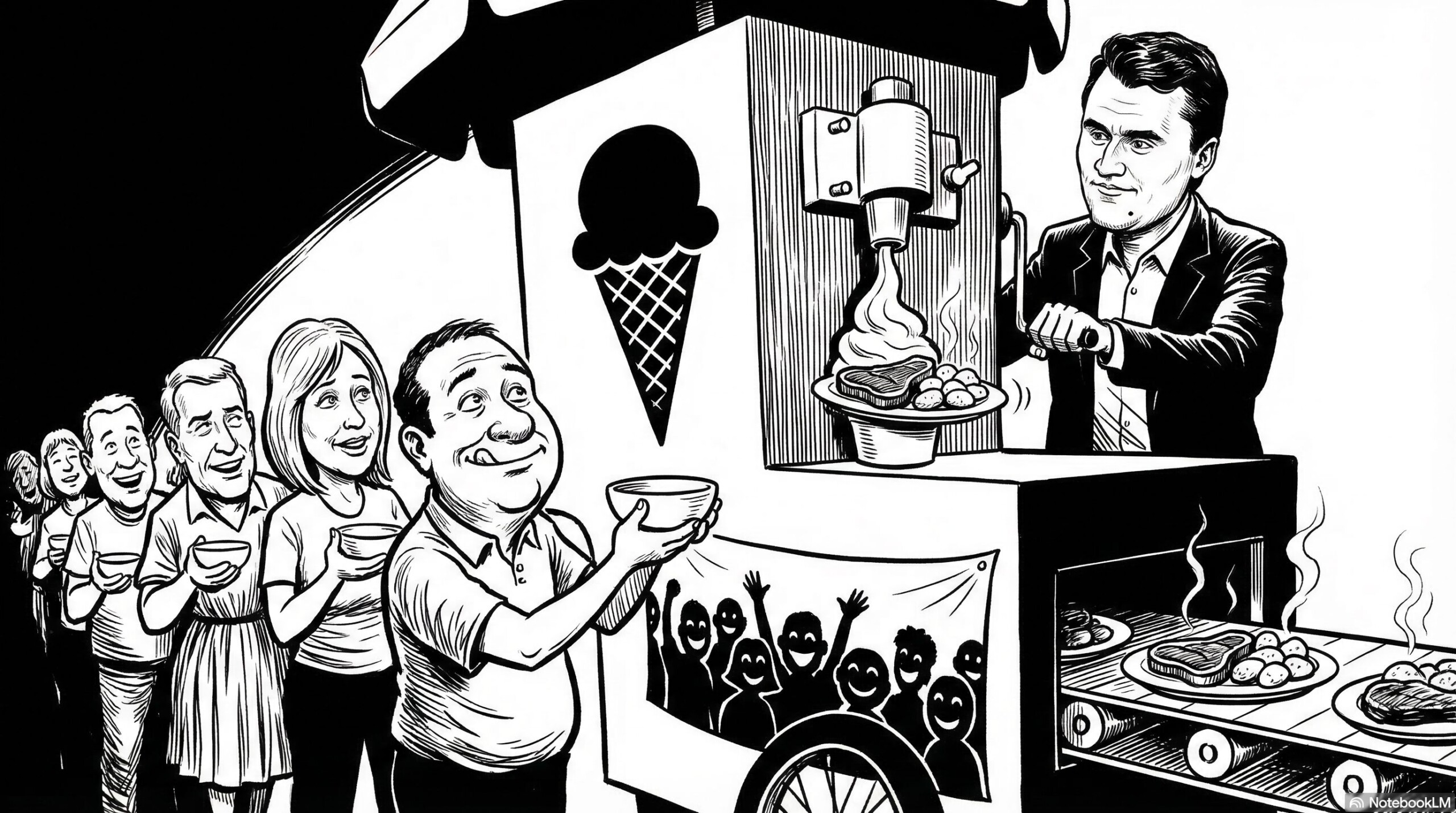
The Ice Cream Problem
Here’s the fundamental asymmetry Charlie faced, and it’s the same one every advocate of Individualism faces: your opponent is offering ice cream and cookies, and you’re offering meat and potatoes.
Collectivism is an easy sell. Someone else will handle it. The government will provide. You don’t have to worry about that — there’s a program for it. It tastes good. It goes down easy. It rots your teeth, but that’s a problem for later.
Individualism is a hard sell. You’re responsible for yourself. No one owes you a living. Freedom means you bear the consequences of your own decisions. It’s nutritious. It builds strong bones. And almost nobody reaches for it voluntarily when there’s a dessert table across the room.
Charlie had always understood this intellectually. He’d been making the case since high school — debating classmates who’d never heard a conservative argument, writing for Breitbart at seventeen, going on Fox News at eighteen. But campus debates are one thing. National politics is another. On campus, you can win by having the better argument. In national politics, the better argument loses to the better delivery system every single day of the week.
The period from 2016 to 2024 is the story of Charlie building a better delivery system — and confronting, at every turn, the question of how much of the ice cream business you can adopt before you’ve stopped selling meat and potatoes entirely.
Are You Charlie?: If you’re trying to convince people of something that requires effort — self-discipline, personal responsibility, delayed gratification — how do you compete with someone who’s promising the easy version? Have you actually solved this problem, or have you just been complaining that people don’t listen?
The Trump Alliance
Charlie’s relationship with Donald Trump is the most visible example of the delivery-system problem. Charlie admitted at the 2016 RNC that he “was not the world’s biggest Donald Trump fan.” Then he became one of Trump’s most effective advocates, eventually earning a seat at the table that few political operators twice his age ever reach.
The cynical read is that Charlie sold out, abandoned his principles for access. The honest read is more interesting and more useful. Charlie recognized something that a lot of principled conservatives missed: Trump was the delivery system. He was the guy who could actually win. Not because his arguments were more rigorous than Charlie’, they weren’t, but because Trump understood something Charlie had been learning since the garage: most people don’t respond to arguments. They respond to confidence, to energy, to the feeling that someone is fighting for them. Trump was the ice cream that happened to have a steak inside.
After Trump’s 2016 win, Charlie became a regular on political talk shows and earned a reputation for being able to explain Trump’s policies more clearly than Trump himself. That’s a revealing detail. Charlie wasn’t just riding Trump’s coattails, he was translating Trump’s instincts into frameworks. He was the guy who could take the raw populist energy and explain why it was actually consistent with free-market principles and limited government. He became the bridge between the meat-and-potatoes conservatives who distrusted Trump and the Trump voters who’d never read Milton Friedman.
By 2018, Charlie hosted the “Generation Next Summit” at the White House. Trump personally attended. Charlie made the Forbes “30 under 30” list. The kid from the garage was now a player, not because he’d abandoned his principles, but because he’d found a vehicle that could actually deliver them to people who’d never have listened to a policy lecture.
The question Charlie had to answer, and that anyone claiming to “be Charlie Kirk” has to answer, is whether the vehicle changes you or you change the vehicle. That question doesn’t have a clean answer. It has a daily answer, decided one compromise at a time.
Are You Charlie?: Have you ever aligned with someone whose style you didn’t love because they could actually move the ball? What did that cost you? What did it gain? And can you honestly say you didn’t start enjoying the ice cream a little?
The Media Machine
Charlie’s media expansion during this period is staggering by any measure. The Charlie Kirk Show grew to over 120 million downloads in a single year, syndicated on more than 150 radio stations, consistently in the top ten on Apple News. His social media reach exceeded 100 million people per month. Axios listed him among the ten most engaged accounts in the world.
This matters for the “Being Charlie” thesis because it represents another gear-shift, from building an organization to building a platform. Turning Point USA was a campus operation. The Charlie Kirk Show was a media brand. They served the same cause, but they required different skills and carried different temptations.
The temptation of a massive platform is that the platform becomes the product. You start curating for engagement instead of truth. You learn which arguments get clips shared and which ones make people change the channel. The algorithm rewards heat over light, every single time. Charlie published four books during this period, including The MAGA Doctrine, which hit number one on both Amazon and the New York Times bestseller list. The books were the meat and potatoes, extended arguments, frameworks, sustained thinking. The podcast clips were the ice cream, punchy, shareable, emotionally satisfying. Charlie needed both. The question is always which one is driving.
The revenue numbers tell their own story: $8.2 million in 2016–17, up to $28.5 million by 2019, $55.8 million by 2021. By 2024, Turning Point had over 400 staffers and chapters at more than 1,000 campuses. Charlie opened a national headquarters in Phoenix. He launched Turning Point Action, a 501(c)(4) that could engage directly in partisan politics. He launched annual conferences, Student Action Summit, Young Women’s Leadership Summit, Young Black Leadership Summit, AmericaFest, that drew thousands.
He built, in other words, exactly the kind of institution that the Illinois GOP told an eighteen-year-old kid wasn’t a good idea. And he did it by mastering the very thing the cause of Individualism is supposed to distrust: large-scale organizational power.
Are You Charlie?: Do you understand the difference between a platform and a megaphone? A megaphone amplifies your voice. A platform sustains it. Kirk built a platform. Most people who say “I am Charlie Kirk” have a megaphone — a social media account, a podcast with twelve listeners, a blog. What would it take to turn yours into a platform? And do you have the discipline to keep the message honest once the audience gets large enough to make dishonesty profitable?
The Faith Integration
Early Turning Point was deliberately secular. The 2017 chapter guide explicitly avoided social issues, no focus on abortion or traditional marriage, just free markets and fiscal responsibility. Charlie was building a tent, and he knew that culture-war issues narrow tents.
Over time, that changed. Charlie’s personal faith, always present but not always central to the organization, became increasingly visible. By 2021, he’d launched TPUSA Faith. He began framing political battles in spiritual terms. His pastor, Rob McCoy, encouraged him to stop compartmentalizing his Christianity from his political work.
This is where the hostile press applies a Label designed to invoke fascism by association. What actually happened is simpler and more honest: Charlie stopped pretending his worldview was separable from his faith. The early secular strategy was tactical. It was ice cream, make the message palatable, don’t scare off the libertarian-leaning college kids with talk of God. The faith integration was meat and potatoes, this is what I actually believe, and I’m done pretending otherwise.
Whether this was strategically wise is debatable. It undeniably narrowed the tent in some directions while deepening it in others. Charlie traded breadth for depth, fewer persuadable college libertarians, more committed Christian conservatives who’d show up, donate, and build chapters that lasted longer than a semester. From a pure organizational standpoint, depth usually beats breadth. A thousand people who believe in the cause will outwork ten thousand people who think the cause is kinda cool.
But here’s the tension that connects back to the meat-and-potatoes paradox: when Charlie led crowds in chanting “Christ is King” at political rallies, was he selling conviction or selling emotion? Was that meat and potatoes or ice cream in a different flavor? That’s not a question I can answer for Charlie. It’s a question every person of faith in politics has to answer for themselves, honestly, every single time they open their mouth.
Are You Charlie?: If your convictions include your faith, are you willing to put them front and center even when it costs you allies? And if you do — are you doing it because it’s true, or because the crowd energy feels righteous? The honest answer might be both. The dangerous answer is pretending it’s only the first.
The Kingmaker
The most telling development of this period isn’t the podcast numbers or the revenue growth. It’s J.D. Vance.
Vance connected with Charlie after a 2017 Fox News appearance. Charlie introduced Vance to Donald Trump Jr. and the broader Trump orbit. When Vance ran a long-shot Senate campaign in Ohio in 2022, Charlie supported him early. When it came time for Trump to choose a running mate in 2024, Charlie was a key voice pushing for Vance.
Think about what that represents. A kid who started in a garage twelve years earlier was now influencing who runs for the United States Senate and who gets picked for Vice President, and who will most likely be our next President. That’s not campus organizing. That’s not media influence. That’s political power, the real kind, the kind that shapes who governs.
And Charlie exercised it from the outside. He never took a government position. He never ran for office. When the 2024 election was won and administration jobs were being discussed, Charlie stayed independent, reportedly because he recognized his influence was greater outside the structure than inside it. This is the same instinct that drove him at eighteen when the Illinois GOP said no: go around the institution, don’t join it.
The “Being Charlie” lesson here is uncomfortable. Charlie didn’t just advocate for liberty, he became a political operator. He learned which levers to pull, which relationships to cultivate, which endorsements to make and when to make them. He became, in other words, exactly the kind of power player that Individualists are supposed to be suspicious of. The difference, and this is the difference that matters, is that he never stopped being accountable to an audience that could walk away. He wasn’t a bureaucrat protected by institutional inertia. He was a broadcaster and organizer whose power lasted exactly as long as his audience trusted him.
That’s the tightrope. And that’s the real “Being Charlie” for this phase of his life: can you accumulate the power necessary to advance liberty without becoming the kind of person who enjoys power for its own sake?
Are You Charlie?: Influence isn’t evil. But it’s dangerous. If you’ve built any — in your community, your workplace, your church — what are you using it for? And would you give it up tomorrow if the cause required it? Kirk stayed outside the government because he thought he was more useful there. That’s a calculation, not a sacrifice. Know the difference.
The Meat-and-Potatoes Test
By the eve of the 2024 election, Charlie Kirk had built one of the most powerful conservative organizations in America, a media empire with a daily audience of over a million, and a personal network that reached into the highest levels of Republican politics. He’d done it by mastering the very thing his cause nominally opposes: large-scale political manipulation.
The paradox is real and it doesn’t resolve cleanly. Charlie offered meat and potatoes through an ice cream delivery truck, and the record suggests it worked, not perfectly, not without compromises, but it worked. The alternative was to stay pure and stay irrelevant, which is a choice a lot of principled Individualists make and then wonder why the world keeps drifting toward Collectivism.
The people who say “I am Charlie Kirk” rarely mean this part. They mean the debates and the rallies and the crowd energy. They don’t mean the eighteen-hour days of political calculation, the relationships cultivated over years for a single strategic moment, the daily negotiation between what you believe and what you can actually sell to a populace that would rather have dessert.
Being Charlie: The Persuasion Study
Charlie Kirk’s genius wasn’t argument; it was delivery. He understood that most people don’t change their minds because of logic. They change because someone they trust made them feel like the idea was worth considering. That’s the ice cream truck selling meat and potatoes.
Your homework today is to study how influence actually works, not how you wish it worked.
- Watch one full Charlie Kirk campus debate (they’re still on YouTube). Don’t watch to agree or disagree. Watch how he handles the crowd, how he reframes hostile questions, how he uses humor to lower defenses before delivering the substance. That’s technique, and it’s learnable.
- Read How to Win Friends and Influence People by Dale Carnegie. It’s eighty years old, it’s still in print, and Charlie’s entire campus strategy is a live-action version of its principles. If you’ve already read it, read it again, this time watching for how Charlie applied it.
- Find one person this week who disagrees with you on something political and have an actual conversation. Not a debate. A conversation. Ask them why they believe what they believe. Listen to the answer. Charlie spent a decade doing this on hostile campuses. You can do it once over coffee.
Charlie solved the meat-and-potatoes problem by understanding that people buy the messenger before they buy the message. If you can’t make someone want to listen to you, it doesn’t matter how right you are.
Tomorrow, Part 4: the 2024 election — and the moment Charlie Kirk’s machine was put to its ultimate test.
The Full Series…
Monday, Part 1: Just a Kid.
Tuesday, Part 2: The Gear Shift
Today, Part 3: Meat and Potatoes (Later TPUSA)
Thursday, Part 4: The Generator (The 2024 election)
Friday, Part 5: The Vacuum (The Victory Lap and The End)