Fourth in a five-part series on what it would actually take to mean it when you say “I am Charlie Kirk.”
There’s a moment in The Great Gatsby that most people remember wrong. They remember the parties, the music, the lights, the crowds pouring into Gatsby’s mansion. They remember the green light across the water. What they forget is how the story ends: not with Gatsby’s death, but with the observation that the people who destroyed him were careless. They smashed things and retreated into their money, and let other people clean up the mess.
Gatsby’s crime wasn’t failure. It was success, the wrong kind, achieved the wrong way, by the wrong person. He didn’t inherit his fortune; he built it. He didn’t join the old-money establishment; he built a bigger house next door. He threw open the doors and invited everyone, and for a while it worked. But the moment his success threatened the structure that the old money depended on, the system disposed of him. Not by confronting him directly, Tom Buchanan didn’t pull the trigger. He pointed the gun in the right direction and let someone else do it.
Part 3 of this series ended with Charlie Kirk on the eve of the 2024 election, having built one of the most powerful conservative organizations in America. He’d mastered the paradox of selling meat and potatoes through an ice cream delivery truck, using the tools of political manipulation to advance the cause of individual freedom. That was the lesson of Part 3: the tension between the message and the method.
Part 4 is about what happened when the method actually worked. And why that made Charlie Kirk the most dangerous man in American politics, not to his opponents on the Left, but to everyone who profited from the way things had always been done.
From Manipulation to Machinery
Part 3’s central question was whether you could sell Individualism using Collectivist tools without losing the message in the process. Charlie’s answer, by 2024, was practical rather than philosophical: you build a machine.
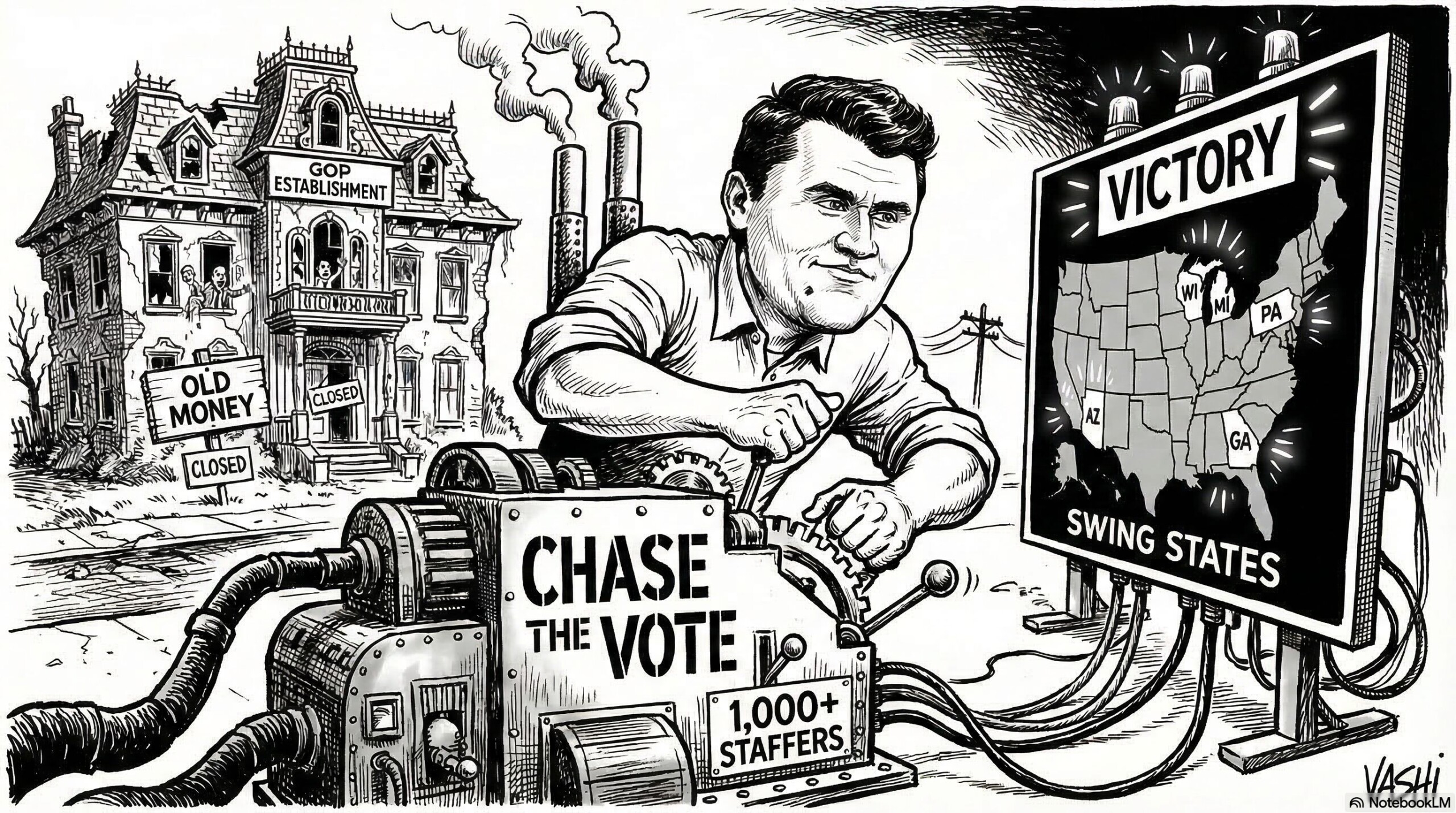
The machine was called Chase the Vote.
Here’s what it actually was. Turning Point Action hired over a thousand full-time “ballot chasers”, not volunteers, not interns, paid staff, and deployed them into communities in Arizona, Wisconsin, Michigan, and Nevada. Each staffer carried a list of four hundred to six hundred names. Not random names. Specific people identified through years of data modeling as right-leaning low-propensity voters, people who would vote for Trump if they voted, but who, left to their own devices, probably wouldn’t vote at all.
The strategy wasn’t persuasion. Charlie was explicit about this. They weren’t trying to change anyone’s mind. They were trying to change their behavior. The ballot chasers were recruited from the same communities they’d be working in, your neighbor, your fellow churchgoer, the guy you recognize from the gym. They built relationships over months, not days. And then, over a thirty-day window before the election, they drove turnout.
This was the lesson of Part 3 made operational. Charlie had spent a decade learning that most people don’t respond to arguments, they respond to relationships, to energy, to the feeling that someone cares whether they show up. He’d watched Democrats master this for years. Now he built the conservative version, and he built it bigger.
Are You Charlie?: Charlie didn’t just talk about getting people to vote. He built a system — with paid staff, data models, and a thirty-day execution window — to actually make it happen. Whatever cause you’re working on, do you have a system? Not enthusiasm. Not good intentions. A system. What would it look like to build one?
The Generator
There’s an important distinction to draw here, because the popular narrative gets it wrong.
Charlie Kirk did not create Donald Trump’s coalition. Trump attracted Tulsi Gabbard, Elon Musk, Robert F. Kennedy Jr., and the broader collection of disaffected, anti-establishment figures on his own gravitational pull. Trump is the magnet. He draws people in through sheer force of personality and the conviction that he’s fighting the same enemy they are.
But a magnet sitting on a table doesn’t power anything. You need a generator — something that takes the magnetic force and converts it into usable energy. Charlie built the generator.
Chase the Vote was the mechanism that turned “I support Trump” into “I actually cast a ballot.” The rallies where Trump, Vance, RFK Jr., and Gabbard appeared together, those were Turning Point Action events. The campus tour that produced two billion social media views, that was Charlie’s operation. The data infrastructure that identified hundreds of thousands of low-propensity voters, that was Charlie’s team.
The numbers tell the story. In Wisconsin, Chase the Vote turned out over seventy thousand low-propensity voters. Trump won the state by twenty-eight thousand. In Arizona, they chased more than two hundred thousand ballots. Trump won by a hundred and eighty-five thousand. In Juan Ciscomani’s congressional district, they chased twenty thousand ballots. Ciscomani won by under five thousand, and his win was the one that clinched the House majority for Republicans.
Charlie didn’t just contribute to the 2024 victory. He provided the margin. Without Chase the Vote, the math doesn’t work. And everyone who understood electoral mechanics knew it.
Are You Charlie?: Charlie’s power wasn’t just influence — it was operational capacity. He could deliver votes in numbers large enough to determine outcomes. If you’re involved in anything political, what’s your operational capacity? Not your follower count. Not your reach. How many actual votes, actual actions, actual results can you deliver?
The Man Outside the Gates
Here’s where the Gatsby parallel sharpens.
Charlie built all of this from outside the Republican Party structure. This was the same instinct he’d had at eighteen, when the Illinois GOP told him a youth conservative group wasn’t a good idea and he built Turning Point without them. By 2024, that garage startup had more ground-game capacity in key swing states than the Republican National Committee itself.
Think about what that means from the perspective of the people who run the party. The RNC’s entire institutional purpose is to be the organization that wins elections for Republicans. Their fundraising, their staffing, their donor relationships, their political influence, all of it depends on being the indispensable infrastructure between conservative energy and electoral victory.
Charlie made them dispensable. He proved that an outside organization, built from scratch by a kid who never held office and never joined the party apparatus, could outperform the entire institutional Republican machine at its core function. That’s not a compliment to the party establishment. That’s an existential threat.
And Charlie knew it. When the 2024 election was won and administration jobs were being discussed, he stayed outside. He never took a government position. He reportedly recognized that his influence was greater independent than it would be inside the system. The same calculation, made for the same reason, as when he was eighteen: go around the institution, don’t join it.
Gatsby didn’t try to become old money. He built new money. And old money couldn’t tolerate the proof that their position wasn’t necessary.
Are You Charlie?: Charlie built power outside the system and kept it there. The system’s gatekeepers — the people whose influence depends on being the only path to power — couldn’t control him. If you’re building something, are you building it inside an existing structure or outside it? Both have costs. Kirk chose outside, and the cost was that nobody inside had a reason to protect him.
The Dual Threat
This is the part that most post-assassination commentary missed, because it requires thinking about Charlie from two directions at once.
To the Democratic Party and the broader Left, Charlie Kirk was a straightforward enemy, an effective conservative organizer who helped win elections for the other side. That’s a political problem, and political problems have political solutions. You beat them at the next election.
But to the Establishment wing of the Republican Party, the Washington Generals who’ve spent decades losing gracefully to the Democrats’ Harlem Globetrotters, Charlie was something worse. He was proof that the game was rigged only because the players allowed it to be. The consultant class, the RNC infrastructure, the donor-management ecosystem, Charlie demonstrated that all of it could be replaced by a thirty-one-year-old with a podcast and a data team.
It’s argued by some that American politics is controlled by a cabal of Powerful Elites who run both parties from behind the curtain. I don’t see the evidence for that in the GOP’s recent behavior, if the cabal were omnipotent, Trump doesn’t win in 2016, let alone 2024. But the weaker version of the argument is harder to dismiss: that elements of the Establishment wing function as controlled opposition, maintaining the appearance of a two-party contest while ensuring outcomes the Political Elite can live with. Not a conspiracy, a culture. Not a plan, an incentive structure. People don’t need to be told to protect the system that feeds them; they do it by instinct.
Charlie threatened both sides of that arrangement. He threatened the Left because he could deliver votes. He threatened the Establishment Right because he proved their infrastructure was unnecessary. And he did it all from the outside, where nobody had leverage over him.
That’s Gatsby. Not just successful, successful in a way that humiliated the people who considered success their birthright.
Are You Charlie?: Do you understand who you’re actually threatening? Most political activists think their enemies are on the other side. Charlie’s story suggests the more dangerous enemies might be on your own side — the people whose institutional power depends on you needing them. If you don’t need the gatekeepers, the gatekeepers need you gone.
The Loaded Weapon on the Table
Now connect the dots.
By January 2025, Charlie Kirk was the operator who built the machine that won the election. He had a media platform reaching over a hundred million people per month. He had an organization with four hundred staffers and chapters on a thousand campuses. He had the political relationships, he’d helped put J.D. Vance on the ticket. He had the proven campaign infrastructure. And he had no institutional loyalty to anyone who could control him.
He was, in the language of the old horse-racing world, a horse that won every race, and a serious problem for the bookies who profit from uncertainty.
There’s a 1983 film called Phar Lap about an Australian racehorse that dominated so completely, it became a national hero during the Depression. When handicap weights couldn’t slow it down, someone tried to shoot it. When it was brought to race in America and won again, it died under suspicious circumstances, suspected poisoning. The gambling interests who lost money every time it ran were the obvious suspects. It was never proven. It didn’t need to be. The incentive structure explains the outcome without requiring a conspiracy.
Charlie’s assassination didn’t require a conspiracy either.
Here is how you build the conditions for political violence without ever ordering it. First, you label your opponent a fascist. Not a person you disagree with, a fascist. You do this consistently, across media platforms, in academic settings, in cultural commentary, for years. Second, you maintain, also for years, also across every platform, the cultural consensus that fascists are the one category of human being it is acceptable, even virtuous, to destroy. You don’t say “go kill Charlie Kirk.” You say “Charlie Kirk is a fascist,” and separately you say “fascists must be stopped by any means necessary,” and then you wait for someone to do the arithmetic.
The shell casings found at Utah Valley University had messages etched on them. One read “hey fascist, catch.” Another referenced “Bella Ciao” — an Italian anti-fascist anthem. Tyler Robinson, twenty-two years old, didn’t think he was committing murder. He thought he was fighting fascism. The question that matters isn’t what Robinson believed. It’s who taught him to believe it.
You don’t need a cabal. You don’t need a conspiracy. You need an intellectual framework, “these people are Nazis, and Nazis must be destroyed”, repeated often enough and loudly enough that eventually, someone with means and motive picks up the invitation. It’s a loaded weapon left on a table. The people who put it there will express shock when someone picks it up. They’ll call for unity. They’ll say violence is never the answer. And they’ll go right back to calling the next effective conservative a fascist, because the strategy works, it either silences them or it eliminates them, and either outcome serves the purpose.
The careless people. They smash things and retreat into their money and let other people clean up the mess.
Are You Charlie?: This is the part of “Being Charlie” that nobody wants to think about. Charlie walked onto college campuses and engaged with people who’d been told he was a fascist. He did it knowing the risk. He did it because the alternative — staying safe, staying behind a microphone, staying where the bodyguards could control the environment — meant surrendering the thing that made him who he was. The kid who debated in hostile hallways at Wheeling High School never stopped walking into hostile territory. Are you willing to take a risk for what you believe? Not a social media risk. Not a financial risk. The real kind — the kind where the people calling you a fascist might actually believe it enough to act on it.
The Generator Test
By the time Charlie Kirk stepped onto the stage at Utah Valley University on September 10, 2025, he had completed the full arc. He’d gone from a kid reading Friedman in middle school to the operator who built the machine that won a presidential election. Each phase demanded a different version of him, the activist, the fundraiser, the delegator, the media personality, the political strategist, the campaign operator. He made every gear-shift. He solved the meat-and-potatoes problem. He built the generator that converted a coalition’s energy into actual electoral power.
And he did it all from outside the gates. Gatsby, standing in his own mansion, looking across the water at the green light, close enough to see it, never part of the club that controlled it, successful enough to threaten everyone who was.
The people who say “I am Charlie Kirk” mostly mean the rallies and the debates and the energy. They don’t mean the thousand-person field operation built on data modeling and relational organizing. They don’t mean the decade of fundraising in Palm Beach living rooms. They don’t mean walking onto a hostile campus knowing that the people in the crowd have been told you’re a fascist, and going anyway, because the mission requires it.
Part 3 asked whether you could accumulate the power necessary to advance liberty without becoming someone who enjoys power for its own sake. Part 4 asks the harder question: once you’ve built that power, are you prepared for what happens when the people who profit from the status quo decide you’re a threat? Not the people across the aisle, the people behind the curtain, on both sides, who need the game to stay rigged.
Charlie was prepared. Or at least, he acted as though he was. He kept going. He walked into the open air at Utah Valley University, took the microphone, and started answering questions.
He was answering a question about mass shootings when the bullet hit his neck.
Being Charlie: The Threat Assessment
Charlie Kirk built the generator that won an election, and made himself the most dangerous man in American politics to both sides of the establishment. The lesson of Part 4 is that success creates enemies, and the enemies you need to worry about most aren’t the ones across the aisle. They’re the ones on your own side whose institutional power depends on you needing them.
Your homework is a threat assessment. Not paranoia, awareness.
- Identify the gatekeepers in whatever space you’re working in. Who controls access, funding, endorsements, or platforms? What happens to their power if you succeed without them?
- Read The Great Gatsby by F. Scott Fitzgerald. It’s short. Read it with the Charlie Kirk parallel in mind: the outsider who built new money, threatened old money, and discovered that old money doesn’t fight fair. Pay attention to how Gatsby is destroyed, not by confrontation, but by people who simply pointed a weapon in his direction and let someone else pull the trigger.
- Audit your own vulnerabilities. If someone wanted to destroy what you’re building, where would they look? Your private communications? Your staffing decisions? Your financial records? Your social media history? Charlie’s enemies went through his organization’s private texts. What would they find if they went through yours? Not because you’ve done something wrong, but because anything, stripped of context, can be made to look like something wrong.
Charlie built for political combat but not for political espionage. The people who wanted him gone didn’t argue with his ideas. They went through his trash. Build accordingly.
Tomorrow, Part 5: January to September 2025 — the final chapter, and the question of what survives.
The Full Series…
Monday, Part 1: Just a Kid.
Tuesday, Part 2: The Gear Shift
Wednesday, Part 3: Meat and Potatoes
Today, Part 4: The Generator (The 2024 election)
Friday, Part 5: The Vacuum (The Victory Lap and The End)