Fifth and final in a series on what it would actually take to mean it when you say “I am Charlie Kirk.”
In 1982, Christian singer-songwriter Keith Green died in a plane crash at twenty-eight years old. He’d built one of the most dynamic ministries in contemporary Christian music, not just a career but a genuine movement, complete with a ministry campus, a publishing operation, and a following that took him seriously because he took them seriously. He challenged comfortable Christianity the way Kirk challenged comfortable conservatism: by showing up in person and making people uncomfortable.
When Green died, his fans were in shock. He’d built something so large, so personal, so tied to his own energy and conviction, that the obvious question hit everyone at the same time: Who’s going to do it now?
And they answered themselves. I guess I need to.
An untold number of ministries began in that aftermath. People who’d been content to listen to Keith Green realized that listening wasn’t enough anymore. The vacuum pulled them in. It didn’t matter that none of them were Keith Green, what mattered was that somebody had to keep going, and the somebody was them.
That’s the pattern. And it’s the pattern that explains both the power and the tragedy of “I am Charlie Kirk.” The phrase started as exactly that kind of response, the same gut-level answer to the same gut-level question. But a battle cry has a shelf life. Say it long enough without doing anything, and it becomes a bumper sticker. This series has been about what it would take to earn it back.
Before we get to the ending, though, we need to talk about the nine months when Charlie Kirk was winning.
The Lap
Part 4 of this series ended with Charlie having just built the machine that won the 2024 election. Chase the Vote delivered the margins in Arizona, Wisconsin, and the congressional district that clinched the House. Trump flew to Arizona in December specifically to thank him, not a phone call, not a tweet, a personal visit to a Turning Point event where twenty thousand people watched the President-elect publicly credit Charlie for his victory.
Charlie gave the credit to God. That’s worth noting, not because it’s pious, but because it tells you where Charlie’s head was. He wasn’t building a personal brand anymore, he was operating from conviction. At the AmericaFest conference in December 2024, in front of those twenty thousand people, he framed the election as divine intervention, not organizational triumph. The kid who’d read Friedman in middle school had become an Evangelical who kept a Jewish Sabbath, turning off his phone every Friday night.
Are You Charlie? When you succeed — really succeed, the kind where other people notice — do you take the credit or redirect it? Charlie had every reason to spike the football. He’d built the machine, hired the staff, raised the money, chased the ballots. He pointed upward instead. That’s not humility as performance. That’s a man who knows where his power actually comes from.
From there, the victory lap accelerated, though “victory lap” makes it sound like he was coasting. He wasn’t. He was compounding.
January: Charlie flew to Greenland with Donald Trump Jr. on Trump Force One. The President-elect called into their lunch in Nuuk. This wasn’t tourism, it was Charlie operating as a de facto envoy for an administration he’d helped install, testing the political waters on a territory Trump wanted to acquire. He spoke at inaugural events. He was thirty-one years old.
February: The New York Times Magazine profiled him. Charlie told them his goal wasn’t a government job, it was to transform the culture. He signed with Trinity Broadcasting Network for a weekday talk show, Charlie Kirk Today. His podcast had already cracked the top five by weekly downloads. The media footprint was now radio, podcast, television, social media, and live events, simultaneously.
March: Trump appointed Charlie to the U.S. Air Force Academy Board of Visitors. Remember Part 1 of this series, the West Point rejection that radicalized a teenager? Fourteen years later, a President was putting him on the oversight board of a military academy. The kid who wasn’t good enough for West Point was now evaluating how the Air Force Academy trained its cadets.
May: Charlie was in the Oval Office for Jeanine Pirro’s swearing-in. Trump publicly stated that Charlie helped win the election. Days later, Charlie was at the Cambridge Union in England, debating students in front of a packed house. He told the British audience he saw the same populist energy rising in their country that had produced Trump, and challenged them to protect free speech before it was too late. He was exporting the model.
June: Charlie endorsed Nate Morris for U.S. Senate in Kentucky and rallied alongside him. At that Kentucky event, Charlie said something that reads differently now: “We’re on the front lines where it’s not always safe.” He wasn’t being dramatic. He was describing his operating environment accurately.
July: Fox News tapped Charlie to guest host Fox & Friends Weekend. The network that had once tried to distance itself from him was now putting him behind the anchor desk. His podcast was in the top five nationally. His organization had pushed the Trump administration on the Epstein files, Charlie demonstrated he could pressure his own allies, not just his opponents. He wasn’t a cheerleader. He was an independent power center.
August: Charlie attended his first Air Force Academy Board meeting. He pressed the school on construction delays at the chapel and pushed the administration to emphasize American exceptionalism in cadet training. He wasn’t there to collect a title. He was there to use it.
Are You Charlie? Look at that nine-month arc. Charlie didn’t rest on the election victory. He expanded into television, international speaking, military academy oversight, candidate endorsements, and administration vetting — all while maintaining his podcast, his campus tours, and Turning Point’s operations. He compounded his success rather than enjoying it. When you win something, do you pause to celebrate or do you invest the winnings?
The Pattern
Here’s the thing about the victory lap that most people missed while it was happening: Charlie was demonstrating, in real time, every skill this series has cataloged.
The kid who acted instead of talked (Part 1) was still acting, Greenland, Cambridge, Kentucky, Fox News. The organizational builder who learned to delegate (Part 2) was running a four-hundred-person operation across a thousand campuses while simultaneously hosting a daily podcast and a TV show. The strategist who solved the meat-and-potatoes problem (Part 3) was using every media platform available without losing the substance of his message. The outsider who built the generator (Part 4) had translated electoral victory into cultural and institutional influence without joining the government.
Nine months. All of it running concurrently. All of it building on what came before.
And then September.
The End and the Beginning
On September 10, 2025, Charlie Kirk stepped onto the campus of Utah Valley University for the opening event of the American Comeback Tour. Part 4 already told you what happened next. It doesn’t need retelling here.
What needs telling is what happened after.
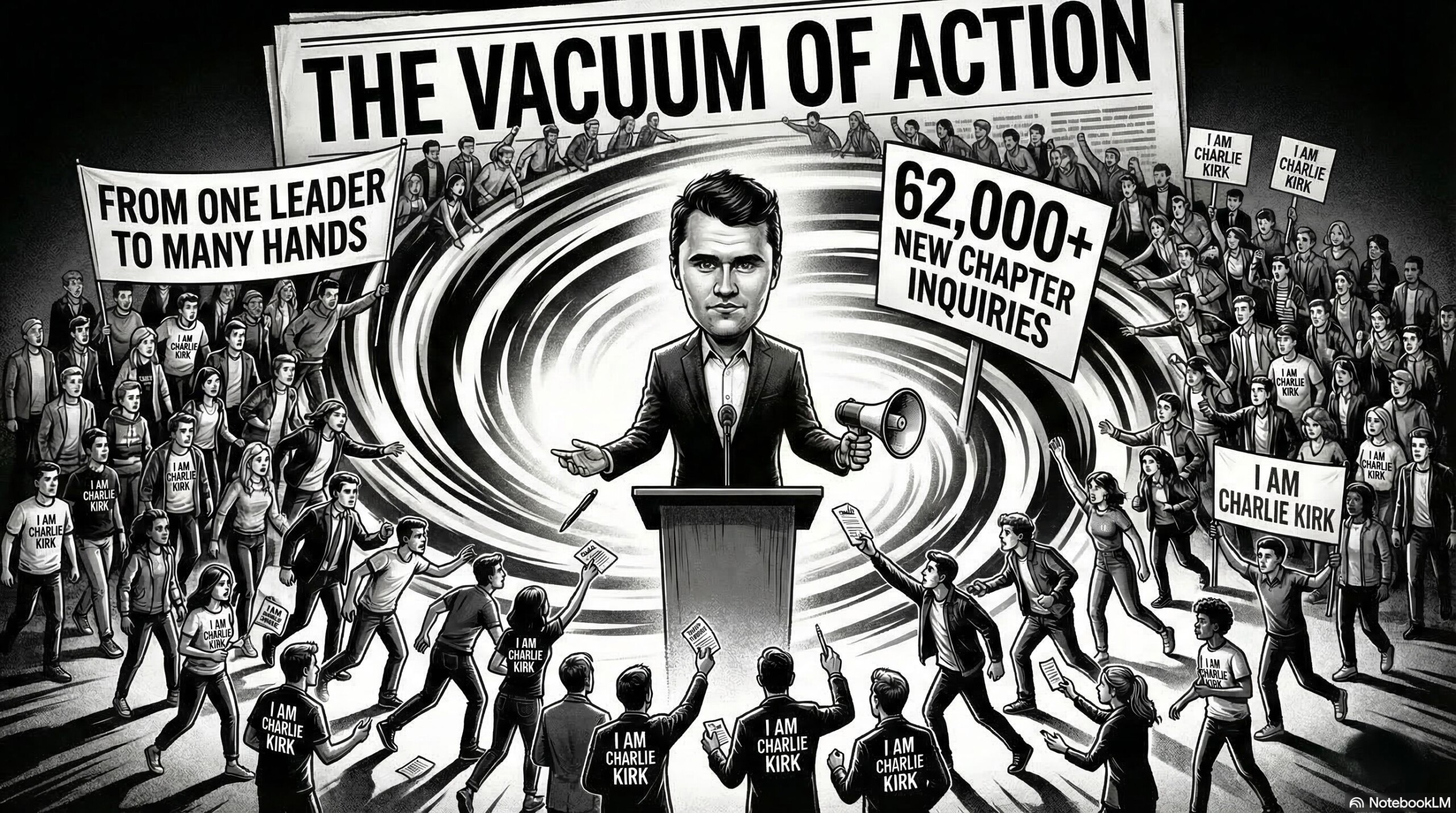
Within eight days, sixty-two thousand students inquired about starting new Turning Point chapters. That number eventually passed a hundred and twenty thousand. Erika Kirk, his wife, who’d been in the audience with their two children when the bullet hit, was unanimously elected CEO of Turning Point on September 18th. Turning Point registered voters at his memorial service. Almost a hundred thousand people attended the memorial at State Farm Stadium. Trump posthumously awarded Charlie the Presidential Medal of Freedom on what would have been his thirty-second birthday.
The machine didn’t stop. It recruited.
This is the Keith Green pattern. The vacuum pulled people in. “I am Charlie Kirk” erupted as a battle cry, genuine, heartfelt, backed by real grief and real resolve. People who’d been content to listen to his podcast realized that listening wasn’t enough anymore. The question hit them: Who’s going to do it now? And they answered themselves.
Are You Charlie? This is the final question, and it’s the hardest one in the series. Not because it’s complicated, but because it requires honesty. Five parts of this series have walked through what it actually took — the reading, the rejection, the action, the fundraising, the delegation, the crises, the paradoxes, the operational machinery, the personal risk. The bumper sticker is easy. The life was not. If you say “I am Charlie Kirk,” are you doing something? Not believing something. Not posting something. Doing something — building something, showing up somewhere hostile, investing your time and your money and your comfort into a cause bigger than your social media presence? Or have you let the battle cry become a bumper sticker?
Being Charlie: The Action Item
Four days of homework. A reading list. An organizational audit. A persuasion study. A threat assessment. All of it preparation.
Today’s assignment is the one that matters: do something.
Not plan something. Not research something. Not post about something. Do something, one concrete action that advances whatever cause you claim to care about. Here are some options, but the list isn’t the point. The point is picking one and doing it before the week is over.
- Volunteer for a campaign. Not “I should look into volunteering.” Actually show up.
- Start the chapter, the group, the organization you’ve been thinking about. File the paperwork. Send the first email. Book the first meeting room.
- Register five people to vote. Not strangers at a table, people you know personally who aren’t registered.
- Write the essay, the article, the letter to the editor you’ve been composing in your head for months. Submit it somewhere.
- Have the conversation with the person in your life who disagrees with you. The face-to-face one you’ve been avoiding.
When Keith Green died, people didn’t start ministries because they’d read a book about starting ministries. They started them because someone had to, and they decided the someone was them. When Charlie Kirk was killed, sixty-two thousand students inquired about starting new chapters in eight days. That’s not grief. That’s the vacuum pulling people into action.
“I am Charlie Kirk” means nothing if you’re still sitting in the same chair you were in when you first said it. Father O’Malley didn’t just say “I am Jewish.” He stood up. He walked forward.
Stand up. Walk forward. The series is over. The work isn’t.
This concludes the “Being Charlie” series.
The Full Series…
Monday, Part 1: Just a Kid.
Tuesday, Part 2: The Gear Shift
Wednesday, Part 3: Meat and Potatoes
Thursday, Part 4: The Generator
Today, Part 5: The Vacuum (The Victory Lap and The End)